Why nylon takes up water
Nylon is a family of polyamides. Its molecular chains contain amide groups that attract water molecules. When a nylon part is exposed to humid air or liquid water, moisture can move into the material rather than simply resting on its surface. This is why wiping a part dry does not necessarily return it to its original weight or size.
Moisture uptake is gradual. Water enters at the surface and moves inward, so a thin wall generally responds faster than a thick section. Temperature, surrounding humidity and the particular nylon grade also matter. A part left in ordinary indoor air may reach a different moisture condition from one used outdoors or repeatedly exposed to water. Neither condition is captured by describing the material simply as “dry” or “wet.”
What moisture does to dimensions
As water enters nylon, it separates and mobilizes portions of the polymer chains. The material tends to swell, so dimensions measured soon after molding may increase during storage or use. Moisture also commonly makes nylon less stiff and more flexible. A change in fit may therefore reflect both a dimensional change and a change in how the part bends under load.
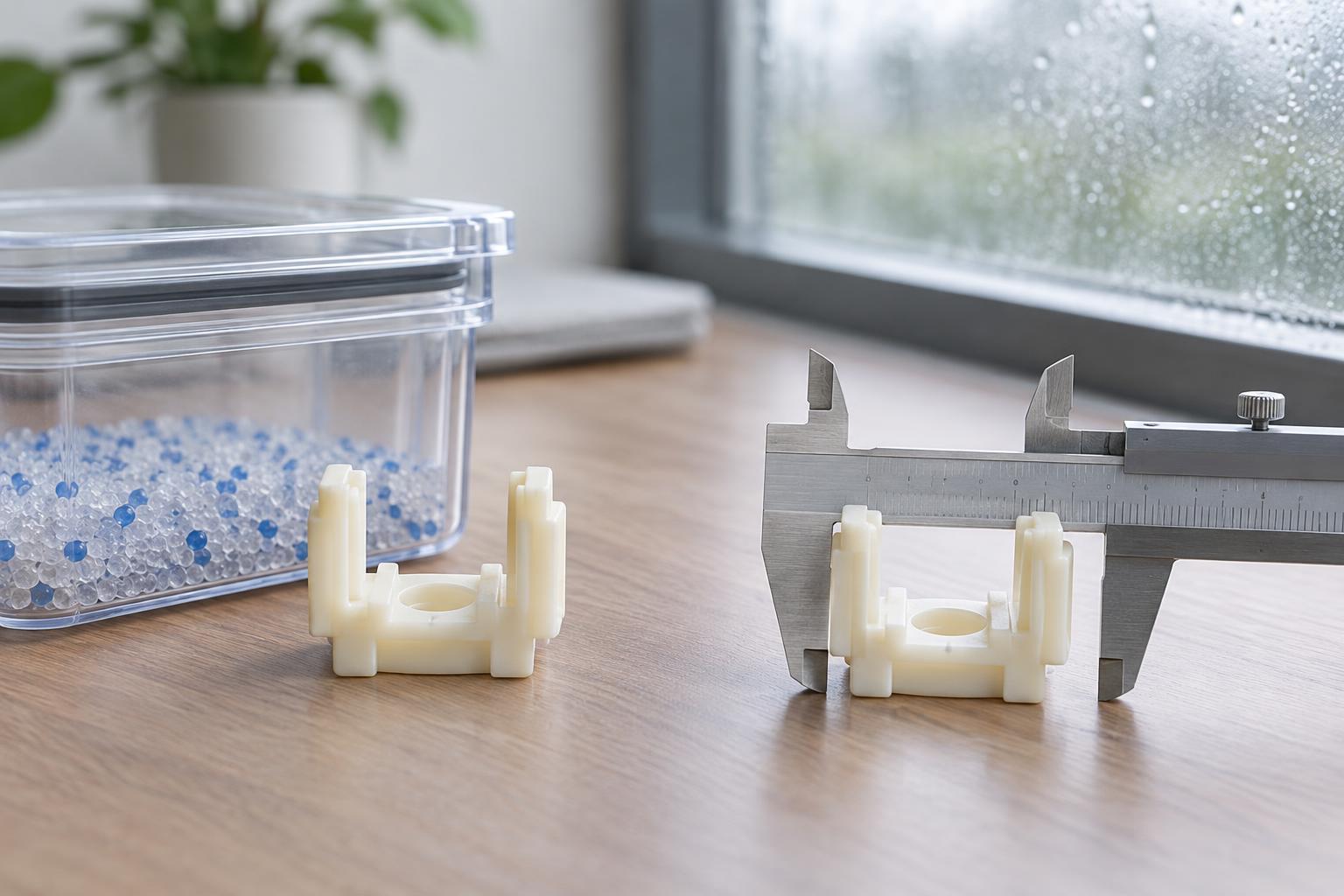
The swelling need not produce an identical change in every direction. A molded part already has a history of flow, cooling and shrinkage; its geometry may also include ribs, thick bosses and thin walls that absorb moisture at different rates. Fiber reinforcement can further influence how a part changes shape. For a close-fitting assembly, a small change across a hole, snap feature or long span may matter more than the overall change in the part.
Moisture-related movement is distinct from molding shrinkage. Shrinkage occurs as the molded material cools and solidifies, while moisture uptake continues afterward as the part approaches the conditions around it. Drying a conditioned part can remove some absorbed water and move its dimensions back toward a drier state, but it should not be treated as a way to erase every effect of molding or service.
Why the material grade and environment matter
Different polyamides do not absorb the same amount of moisture, and filled grades behave differently from unfilled ones. Glass fibers, for example, do not swell like the nylon around them and can restrain dimensional change in some directions. The exact result depends on the formulation and how the fibers are oriented in the finished part. A dimension-change estimate for one grade should not automatically be applied to another.
The intended environment is just as important as the grade. A cover that spends its life in a fairly stable indoor setting presents a different design problem from a component that cycles between damp and dry conditions. If an assembly combines nylon with metal or another plastic, the materials may respond differently to humidity. Clearance that works at one moisture condition may tighten or loosen at another.
Designing and checking for a realistic fit
Start by identifying the dimensions that control function: mating diameters, bearing surfaces, snap-fit features and distances between mounting points. Then decide which moisture condition the specified dimensions are meant to represent. “As molded” and “after conditioning” are not interchangeable inspection states. Recording storage and conditioning conditions alongside measurements makes results easier to compare.
For a demanding fit, evaluate representative parts in the range of environments they are likely to encounter, allowing enough time for thick sections to respond. Measure critical features at consistent points and note any warping or change in assembly force. Where practical, provide clearance or a compliant feature rather than relying on a dry-part dimension remaining unchanged.
Moisture control also matters before molding, but for a different reason. Nylon pellets are commonly dried according to the material supplier’s processing guidance because excess moisture during melting can harm processing and part quality. That step does not prevent a sound finished part from later absorbing moisture in service. Treat processing dryness and in-use conditioning as separate questions.