Start with what the part must do
ABS and polycarbonate (PC) are both used for products such as equipment housings, covers and consumer goods. They can serve similar purposes, but their strengths differ. ABS is often selected for its balance of toughness, moldability and appearance at a relatively accessible material cost. PC is often considered when a part needs greater impact resistance, optical clarity or better retention of properties at elevated temperatures.
Those descriptions are starting points, not guarantees. A thin snap feature, a large panel and a small protective cover put different demands on a plastic. Grade selection, wall thickness, ribs, corners, assembly stresses and the conditions of use can matter as much as the material name. Define the likely drops, loads, temperatures, cleaning chemicals and appearance requirements before comparing prices.
Impact resistance is more than a material rating
PC is generally the stronger candidate when resisting a sudden blow is the primary goal. It can deform substantially before breaking in many applications. ABS also provides useful impact resistance, and it may be entirely adequate for a housing that is unlikely to receive severe blows. Neither material makes a poorly designed part immune to damage.
Impact-test results are useful for screening grades, but they do not predict every real-world failure. A sharp internal corner can concentrate stress; an overly rigid screw boss may crack during assembly; a thin edge may fail even if a thicker test specimen performed well. PC parts can also be vulnerable to stress cracking when certain chemicals contact stressed areas. If a product will be cleaned frequently or exposed to oils or solvents, test the proposed grade and finished design under realistic conditions.
Appearance depends on the finish you need
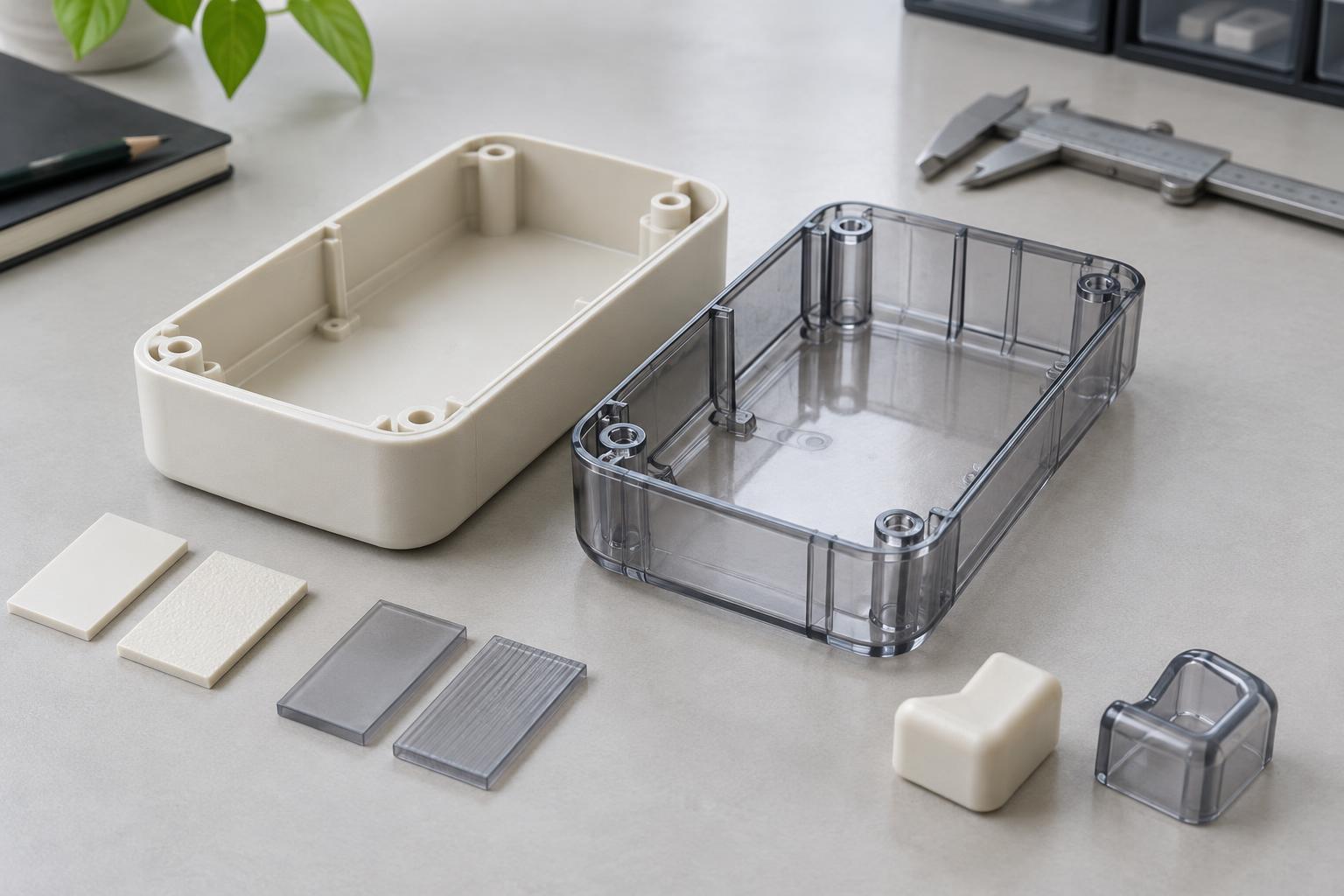
Standard ABS is opaque and is commonly used for colored, textured or painted housings. It can reproduce molded surface details well, making it a practical choice when a consistent cosmetic finish matters. PC can be transparent, which opens up uses such as viewing windows and covers. It is also available in opaque grades, so transparency alone does not settle the decision.
For a visible part, ask what should happen after months of handling. Glossy surfaces may reveal scuffs and fingerprints, while a texture can make minor wear less noticeable. Color matching, paint adhesion, mold texture and acceptable blemishes should be checked with production-intent samples rather than assumed from a resin sample. If the part will see sunlight, consider whether an outdoor-suitable grade, coating or other protection is needed; standard grades should not automatically be assumed to retain their appearance outdoors.
Compare the finished part cost, not just the resin price
ABS is often less expensive to buy than comparable PC, but the price per kilogram is only one component of part cost. PC typically needs more attention to drying and processing conditions, and its higher processing temperatures can affect manufacturing choices. The exact difference depends on the grade, part geometry, supplier and production setup. Poor drying or unsuitable processing can create defects in either material and drive up scrap costs.
Geometry may outweigh a small difference in resin price. If PC allows a design to meet its requirements without a separate protective component, its higher material cost could be justified. Conversely, specifying PC where ABS already meets the need may add expense without a useful benefit. PC/ABS blends offer another option for some housings, combining properties in ways that depend on the particular grade. A blend should be evaluated as its own material, not treated as a predictable midpoint between the two.
Make the decision with representative parts
A sensible first pass is to list non-negotiable requirements: expected impacts, maximum use temperature, chemical exposure, transparency, color and surface finish. Then shortlist grades suited to those conditions. If a product has electrical or fire-performance requirements, check the relevant grade documentation and test the complete design as needed; the broad label “ABS” or “PC” does not establish compliance.
Prototype the part at a representative wall thickness and inspect it after assembly, handling and realistic use. Look at corners, snap fits and screw bosses, as well as the broad cosmetic surfaces. Request cost estimates using the intended grade, finish and production volume so the comparison includes processing and rejected parts, not just raw material. The best choice is the material that meets the product’s actual requirements reliably at an acceptable finished-part cost.