Two ways to turn yarn into fabric
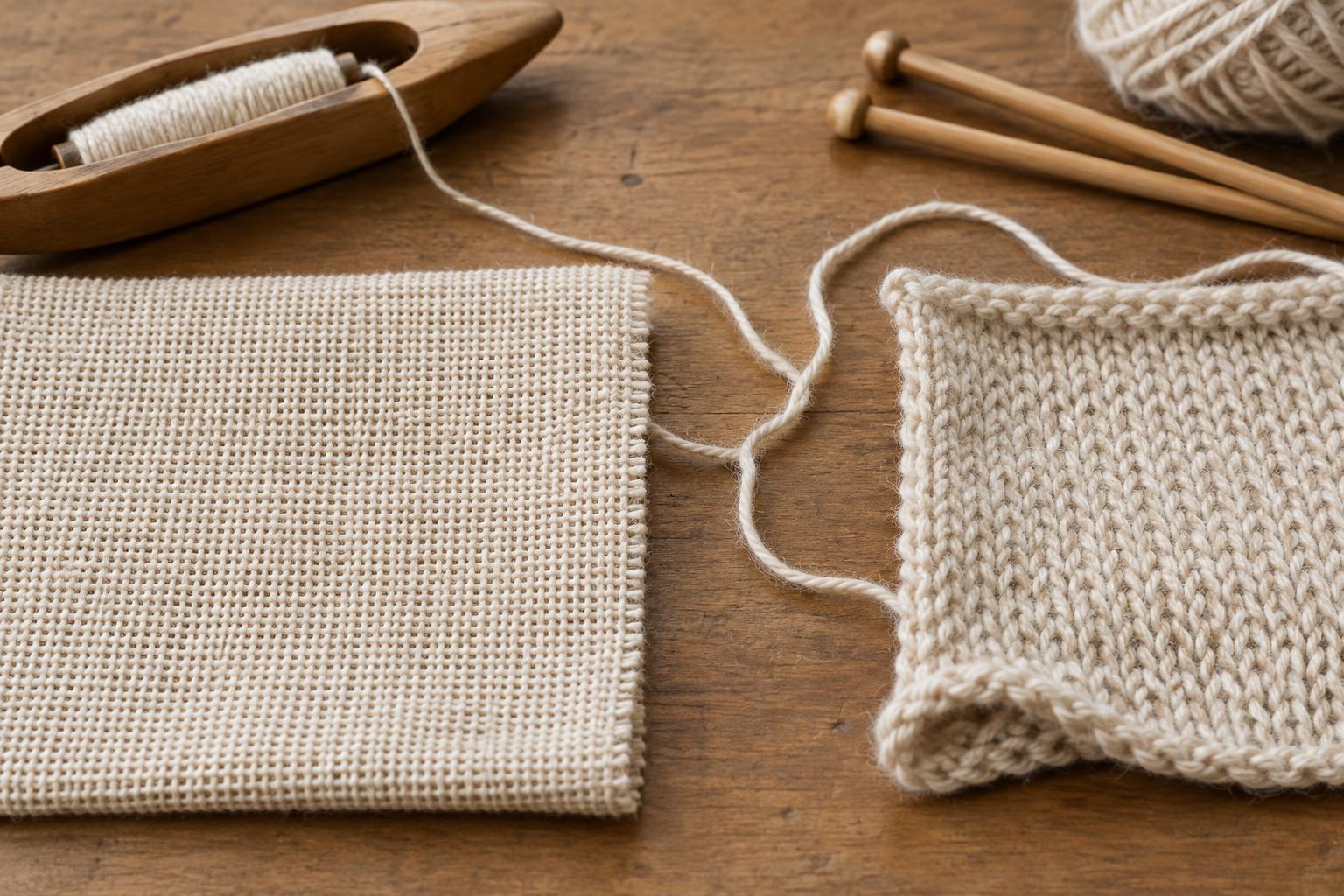
Weaving and knitting both turn yarn into a flexible sheet, but they organize that yarn in different ways. A woven fabric is made by interlacing two sets of yarns, usually at right angles. The lengthwise yarns are called the warp; the crosswise yarns are the weft. A loom holds the warp under tension while the weft passes over and under selected warp yarns. Repeating that sequence builds the cloth.
A knitted fabric is built from connected loops. In weft knitting, a yarn forms loops across a row and continues into the next row; this is the broad family used for many T-shirts and sweaters. Warp knitting uses multiple yarns that form loops along the fabric’s length and connect across it. Both are knitting, but their equipment, structures and behavior can differ. The key contrast with weaving is that knitted yarns bend into loops rather than simply crossing one another.
How structure changes stretch and drape
A knitted fabric can often stretch because its loops change shape when pulled, even if the yarn itself has little elastic stretch. Many weft knits stretch readily across their width and can feel comfortable in close-fitting garments. Woven fabrics generally resist stretching along their warp and weft directions because the interlaced yarns have less room to move. They may give more on the diagonal, often called the bias.
Those are tendencies, not guarantees. An elastic yarn can give a woven fabric substantial stretch, while a dense or specially constructed knit can be relatively firm. Yarn thickness, fiber type, fabric density and finishing all matter. Looser structures may drape softly but distort more easily; firmer structures may hold a defined shape. A product designer therefore needs to evaluate the actual fabric, not choose solely by the words “woven” or “knitted.”
What happens at the edges and seams
The structures also behave differently when fabric is cut. Cut woven edges may fray as yarn ends work loose from the interlacing. Cut knit edges do not usually fray in the same way, but some knits curl, and some can develop a run if a loop breaks and neighboring loops release. These behaviors vary with the construction and the way the fabric has been finished.
Manufacturers account for those differences during sewing. Woven pieces are often finished at their raw edges to limit fraying. Stretchy knits usually need seams that can extend with the fabric; a seam that cannot stretch may break during wear even when the fabric remains intact. Both kinds of fabric can also change dimensions after washing or relaxation. Testing a sample before setting a cutting pattern helps reveal shrinkage, curling or distortion that could affect the finished product.
Production choices behind the fabric
On a loom, changing which warp yarns the weft passes over or under creates different weave patterns. A plain weave uses a simple alternating interlacing, while other arrangements can produce distinct surfaces and drape. Knitting machines instead control how needles form and connect loops. Changing the stitch structure, loop size or yarn can make a knit lighter, thicker, smoother or more textured.
Neither process is automatically faster, cheaper or less wasteful in every situation. The answer depends on the machine, yarn, fabric width, design complexity and production volume. Preparation differs too: weaving typically requires a set of warp yarns to be arranged before cloth production, while knitting has its own yarn-feeding and machine-setup requirements. Once fabric is made, cutting layouts, seam allowances and finishing steps influence how efficiently it becomes a product.
Choosing between woven and knitted fabric
A useful starting question is what the product must do. A structured shirt, sturdy bag or crisp lining may benefit from the dimensional stability of a suitable woven fabric. A close-fitting top, soft cuff or garment intended to move with the body may call for a knit. These are examples rather than rules: construction, yarn and finishing can shift the balance considerably.
When comparing samples, handle and test them in the directions that matter for the product. Check how much they extend and recover, whether they drape as intended, and how their edges and seams behave. Also consider care requirements and whether the finished item must keep precise dimensions. Weaving and knitting are not competing grades of quality. They are different ways of arranging yarn, each offering a set of possibilities and manufacturing trade-offs.