Two ways to make glass safer
Ordinary glass can break into large, sharp pieces. Safety glass is designed to change what happens when a pane fails, but “safety glass” does not describe a single material or guarantee that a pane cannot cause harm. Tempered glass and laminated glass address breakage in different ways: tempering changes the stresses within a sheet, while lamination bonds sheets together with an interlayer.
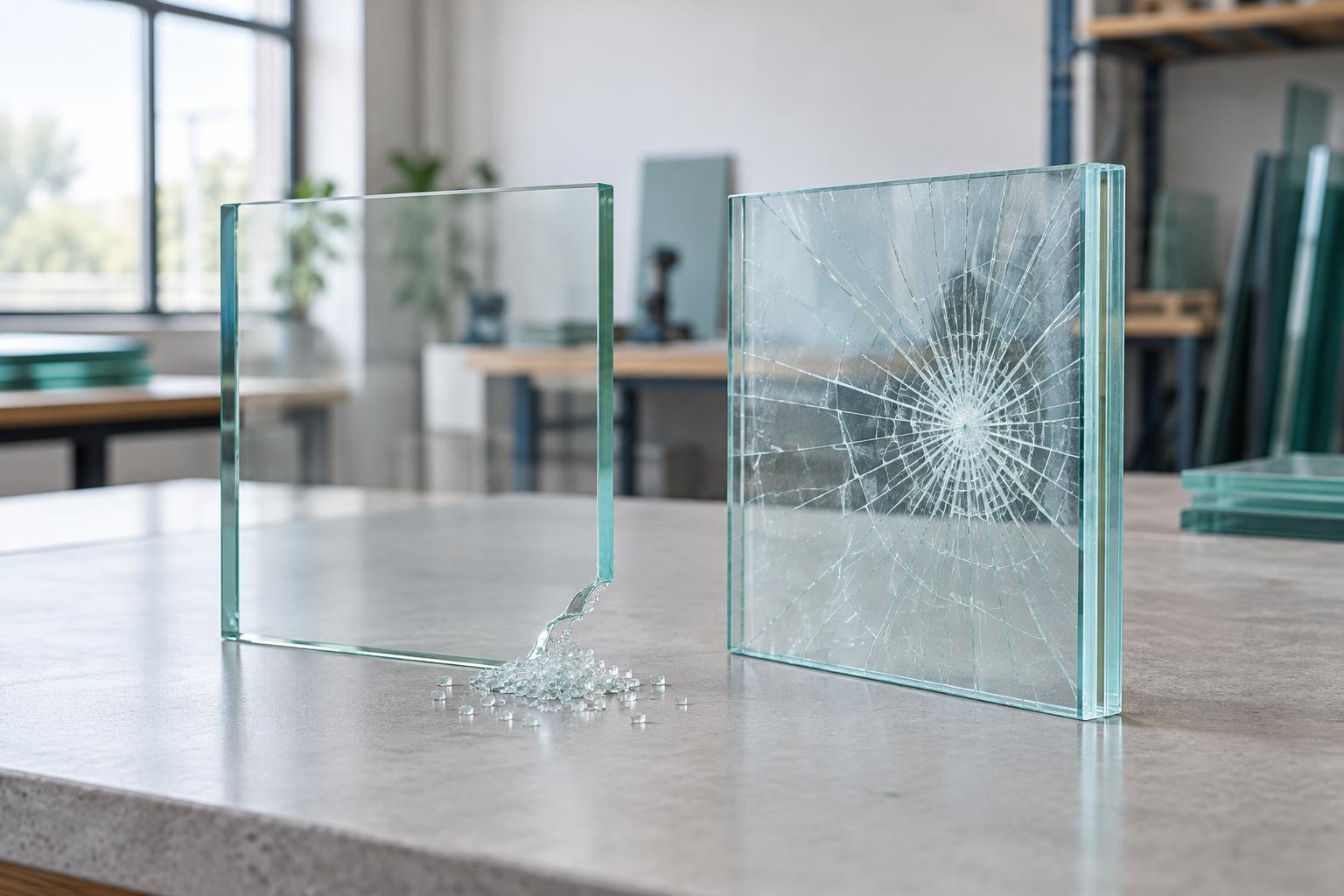
That difference matters most after an impact. Tempered glass typically breaks into many relatively small pieces. Laminated glass may crack extensively, but its interlayer can hold fragments together and help the pane remain in place. Neither behavior is universally better. The useful question is what the glass must do during normal use and, just as importantly, after it breaks.
How tempered glass is made and used
To make conventional thermally tempered glass, a manufacturer cuts and finishes a sheet, heats it, then cools its surfaces rapidly. The process leaves the surfaces in compression and the interior in tension. This makes the finished sheet stronger against certain bending and thermal stresses than comparable untreated glass. It also produces its characteristic fragmentation pattern when the stresses are released by a break.
Tempered glass is often chosen where a strong single sheet and small breakage fragments are useful, such as some shower enclosures, appliance parts and furniture components. Its main limitation is that it does not generally stay together once broken. Edges and openings must also be planned early: cutting or drilling a fully tempered sheet is generally not practical, so those operations are completed before tempering. Surface and edge damage can still cause failure, making careful handling and installation important.
How laminated glass is made and used
Laminated glass is an assembly of two or more sheets bonded around a polymer interlayer. During production, the layers are aligned, air is removed, and heat and pressure create a durable bond. The glass sheets may be untreated, heat-strengthened or tempered, depending on the intended product. Lamination is therefore a construction method, not an alternative to tempering in every case.
The interlayer’s most visible job is fragment retention. If the glass cracks, the bonded fragments can remain attached instead of falling away immediately. This can be valuable where keeping a barrier in place matters, as with vehicle windshields or certain overhead and architectural applications. Interlayers can also be selected for properties such as sound reduction or light control, but performance depends on the complete assembly. A cracked laminated pane still needs assessment and, where appropriate, replacement; retained fragments do not make it undamaged.
Compare the job, not just the label
A useful comparison starts with the likely failure scenario. If an exposed panel breaks, is the priority to reduce the size of loose fragments, or to keep an opening covered? Could people fall through the opening, or could broken glass fall onto people below? These questions help explain why a tempered pane may suit one product while a laminated assembly suits another. In some designs, tempered sheets are laminated together to combine characteristics, though the finished assembly still needs to be evaluated as a whole.
Weight, thickness, edge details and appearance also affect a product decision. A laminated assembly usually contains multiple sheets and an interlayer, while a tempered pane can be a single sheet; comparing them requires actual specifications rather than names alone. Designers may also need to account for exposed interlayer edges, optical effects, cleaning, mounting methods and the way a frame supports the glass. A strong pane in an unsuitable mounting arrangement can still perform poorly.
Questions to settle before specifying
Start by describing the application: panel size, orientation, expected contact, temperature changes and what must happen after breakage. Then ask a supplier for the full build-up, including glass type, thickness, interlayer where applicable, edge finish and any holes or cutouts. Confirm which performance requirements and local rules apply to the intended use rather than assuming that either label alone establishes suitability.
Finally, plan for production and service. Specify how the glass will be supported and protected during shipping, assembly and use, and decide how a damaged pane can be identified and replaced. Tempered and laminated glass are best understood as tools for managing different risks. The right choice follows from the complete product and its failure conditions, not from a simple ranking of one material above the other.