Start with the job the part must do
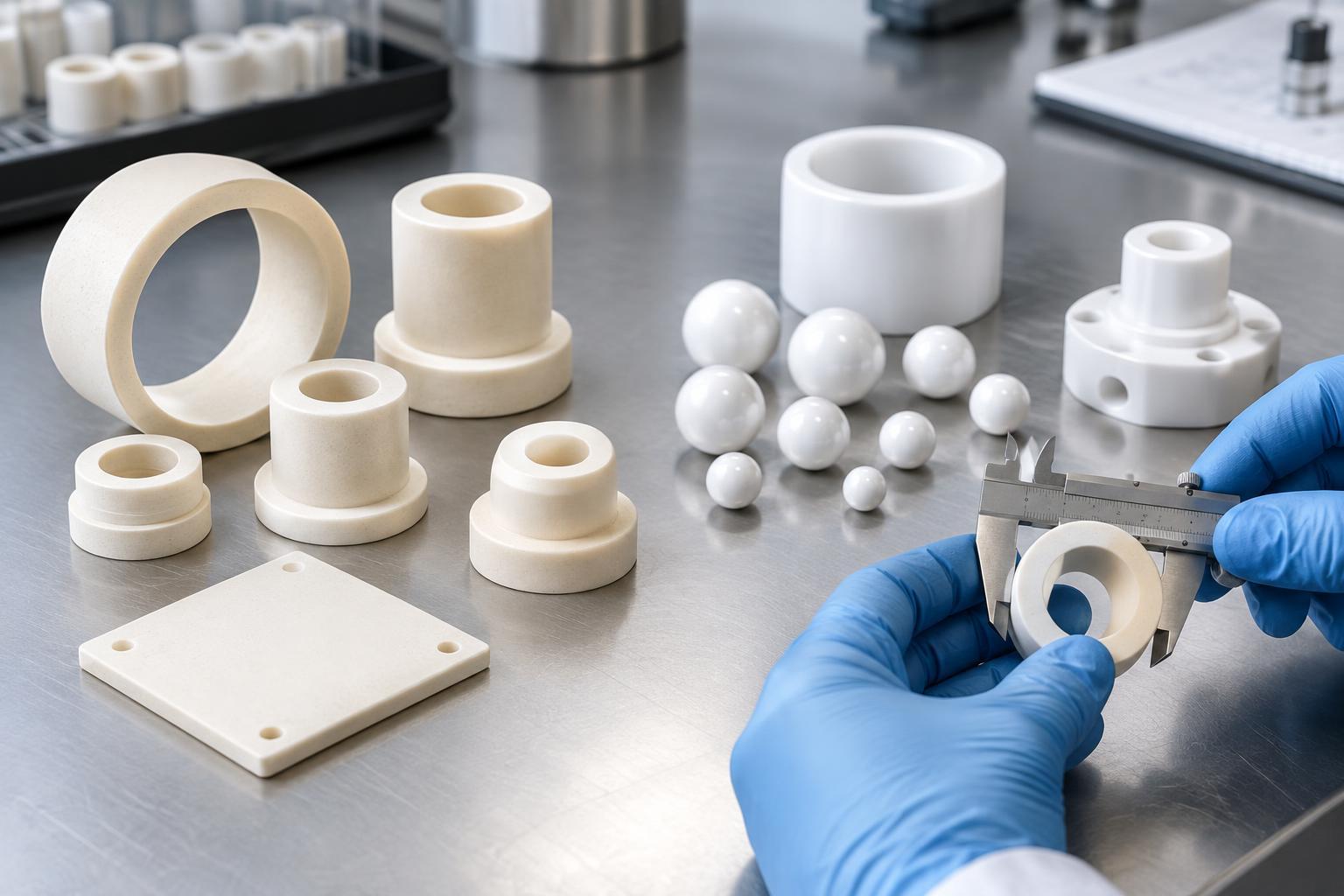
Alumina and zirconia are technical ceramics: inorganic materials shaped and fired to produce hard, stable parts. Both are used in components such as guides, seals and insulating pieces, but they are not interchangeable. The useful question is not which ceramic is better overall. It is which one can meet a particular part’s loads, environment, dimensions and cost target with an acceptable margin.
Define the likely failure mode first. Will the part gradually lose material through abrasion, crack after an impact, distort under heat, or fail because its surface cannot be made precise enough? Also note whether it will contact water, chemicals or another material. These details narrow the choice more effectively than a single property on a datasheet.
Wear resistance is not the same as resistance to cracking
Alumina is valued for hardness, wear resistance and electrical insulation. It is often a sensible starting point for a surface that sees repeated sliding or contact with abrasive material. Grades differ in purity, grain structure and porosity, so two parts described simply as “alumina” may not wear in the same way. Surface finish and the material rubbing against it matter too.
Zirconia is generally more fracture-tough than alumina, particularly in grades engineered to take advantage of a crystal-phase change near a growing crack. That mechanism can make zirconia attractive for small parts with thin features or occasional mechanical shocks. Toughness does not make it unbreakable: sharp corners, scratches and unexpected loads can still start fractures. Nor does it automatically make zirconia the better wear surface in every pairing. Ask suppliers for properties of the specific grade and, where practical, test the intended contact.
Compare behavior in heat and in the operating environment
Both materials tolerate heat, but their thermal behavior differs. Alumina generally conducts heat better than zirconia, while zirconia’s low thermal conductivity can be useful when a part needs to limit heat flow. Whether either material survives rapid temperature changes depends on the grade, shape, thickness and temperature cycle. A simple claim that one is “heat resistant” does not establish that it will withstand repeated heating and cooling in an assembly.
Environment also affects the decision. Some stabilized zirconias can change properties during prolonged exposure to moisture at certain temperatures, a concern often called low-temperature degradation. Its relevance depends on composition and service conditions; it should not be assumed to apply equally to every zirconia grade. Alumina also comes in different grades and can face limits in particular chemical environments. If moisture, cleaning chemicals or heat are important, describe the actual exposure to the supplier rather than relying on a broad material label.
Include electrical needs, geometry and production cost
Alumina is a common choice for electrical insulation, especially where a component must also resist wear or retain its shape at elevated temperature. Zirconia can be electrically insulating too, but some zirconia compositions are selected for specialized conductivity at high temperatures. The distinction is a reminder to specify the required electrical behavior and operating temperature, not just the ceramic name.
Manufacturing can change the apparent value of a material. Zirconia is typically denser than alumina, which may matter in a moving assembly. Both can be difficult to machine after firing, and close tolerances or polished contact faces add work. Shrinkage during firing must also be accounted for when designing a part. A complex shape that looks straightforward on a drawing may require changes to its corners, wall thickness or finishing plan. Compare quotations for finished parts that meet the same requirements, not merely prices for raw material.
Make the choice with a short, testable specification
Alumina is a strong candidate when hardness, insulation and wear resistance are central and the part is protected from severe impact. Zirconia deserves closer attention when fracture resistance or low heat flow is especially important. Neither rule replaces evaluation of a particular grade: forming method, firing, finishing and quality control all influence the finished component.
To request a useful recommendation, give a supplier the part drawing, mating materials, expected loads, temperature range, exposure conditions and required service life. Identify which dimensions and surfaces are critical. If the choice remains uncertain, compare sample parts under a test that resembles use: the same contact, motion, cleaning and temperature changes. Selecting a technical ceramic is less about finding the strongest-sounding property and more about matching a finished part to the way it can fail.