Start with the structure
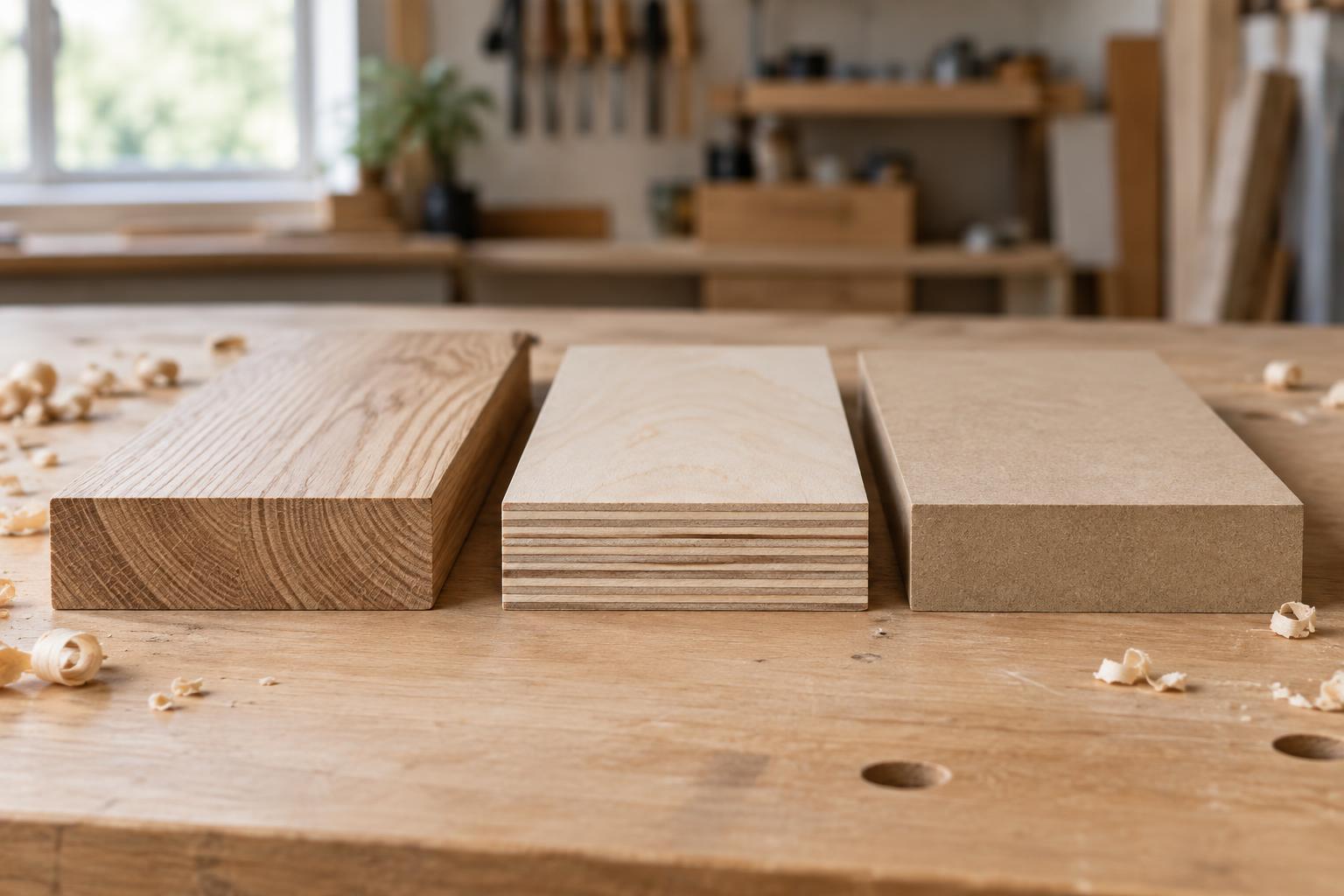
Solid wood is cut from a tree rather than assembled from smaller wood elements. A board has a continuous grain, giving it the variation in color and figure many people want to see in a finished product. Wood species and board quality matter: two pieces of solid wood may differ considerably in hardness, appearance and price.
Plywood is made by bonding thin sheets of wood, called veneers, into a panel. The grain direction usually alternates between adjacent layers. This arrangement helps the panel remain more dimensionally stable than a similarly sized solid-wood board. A plywood sheet has visible layers at its edge unless that edge is covered.
Medium-density fiberboard, or MDF, is made from wood fibers combined with a binder and pressed into a dense, uniform panel. It has no visible grain and no alternating veneer layers. That consistency makes it useful when the surface will be painted or covered, but it does not reproduce the appearance or behavior of solid wood.
How each material responds to moisture
All three materials need protection from unsuitable moisture conditions, but they react differently. Solid wood absorbs and releases moisture from the surrounding air, expanding and shrinking most noticeably across its grain. A wide solid-wood tabletop therefore needs a design that allows some movement; fastening it rigidly in every direction can lead to distortion or splits.
The alternating layers in plywood restrain much of that across-grain movement. Plywood can still swell, warp or delaminate if its construction is unsuitable for the conditions or if water reaches vulnerable edges. Choosing a panel intended for a damp setting is different from assuming that all plywood is waterproof.
Standard MDF is particularly vulnerable when water reaches an unprotected edge or damaged finish. It may swell and lose its smooth shape, and that change is often difficult to reverse. Moisture-resistant MDF products exist, but the label should be checked against the intended exposure. For any board, careful edge treatment and a suitable finish are part of the material choice, not an afterthought.
Cutting, joining and finishing
Solid wood can be shaped, joined and refinished in many ways. Its grain direction affects cutting and fastening, however, and knots or other natural features can change how a particular board machines. It is a strong choice when exposed edges and an authentic wood surface are central to the design.
Plywood offers a broad, flat sheet that can be cut into cabinet sides, shelves or panels with relatively little preparation. Its face veneer determines what is seen, while the core construction affects the quality of cut edges and fastener performance. A decorative face veneer can be thin, so aggressive sanding may expose the layer below. Visible edges can be left as a design feature or concealed with edging.
MDF machines into consistent shapes and provides a smooth face for paint. Its cut edges are more porous than its faces and commonly need extra sealing before finishing. Screws can hold adequately when the joint is designed and drilled appropriately, but repeated removal or poorly placed screws near an edge may weaken the connection. MDF also produces fine dust when cut or sanded, making dust control and appropriate protective equipment important during fabrication.
Look beyond the material name
A label such as “plywood” does not describe every relevant property. Panels vary in veneer quality, core construction, thickness, adhesive and intended use. MDF likewise comes in different thicknesses, densities and specialty grades. For a shelf, span and expected load matter as much as the material name: any of these materials may sag if a long, thin piece is asked to carry too much weight without support.
Weight can influence shipping, handling and hardware selection. MDF is often relatively heavy for its thickness, while plywood weight varies with its wood species and construction. Solid wood varies too. If weight is critical, compare the actual products being considered rather than relying on a general ranking.
Wood-based panels also use binders, and emissions requirements can affect product selection, particularly for indoor applications. Ask for the applicable product information or certification where this matters. Solid wood avoids the panel binder, but adhesives or coatings used in an assembled product may still be relevant.
Match the board to the job
Choose solid wood when visible natural grain, shaped edges or the possibility of later refinishing outweigh the need for a wide, highly stable sheet. Choose plywood for large panels where dimensional stability, a useful strength-to-weight balance and a wood-veneer surface are priorities. Choose MDF when a uniform surface, painted finish or precisely machined profile matters most and moisture exposure can be controlled.
Many products combine materials rather than choosing just one. A cabinet might use plywood for its case, MDF for painted doors and solid wood for a visible trim detail. The best comparison begins with the product’s conditions of use: what will be visible, where water might reach it, how it will be fastened and how much it must support. Those questions turn three broad material names into a workable specification.