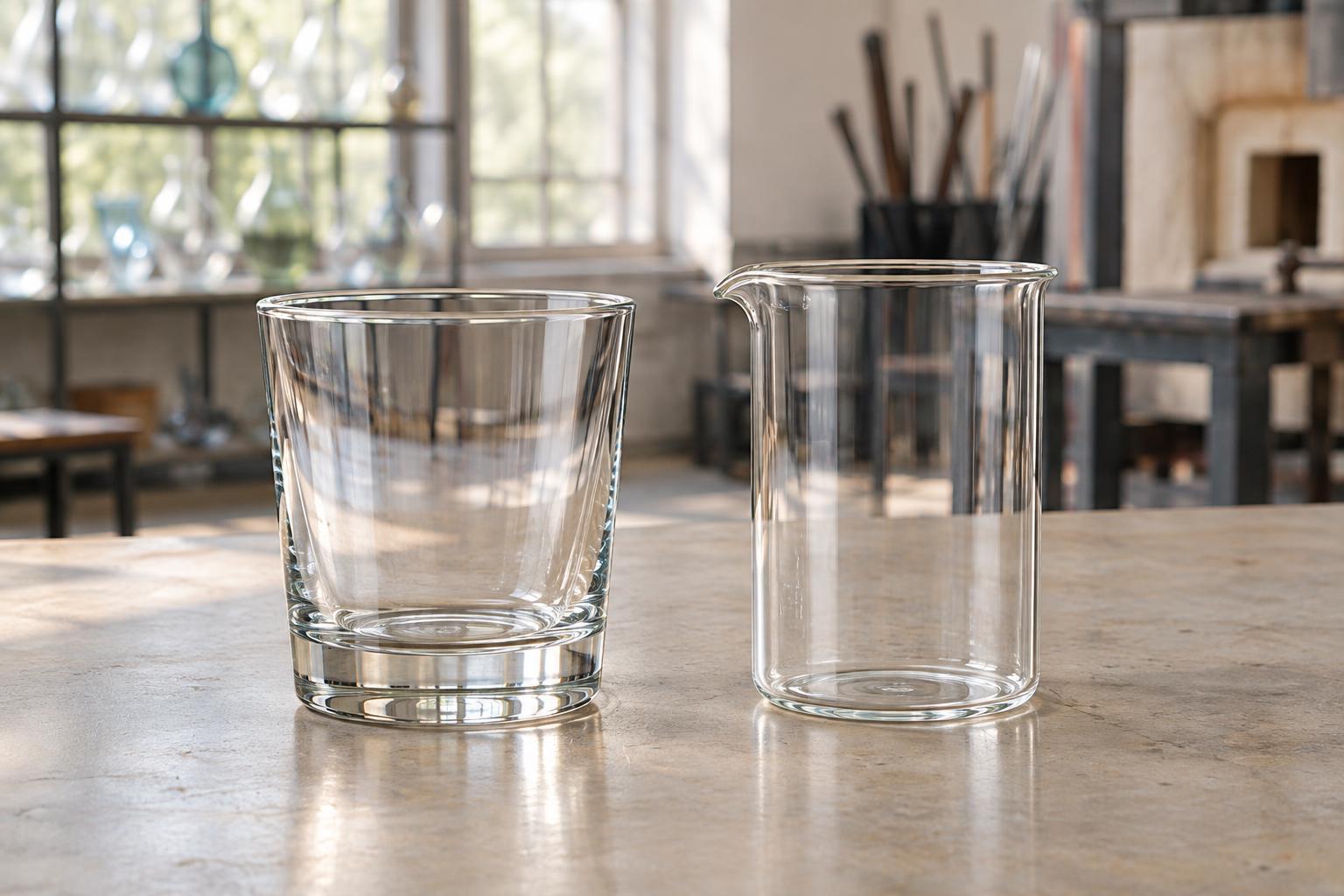
Two glasses with different ingredients
Most everyday bottles, jars and window panes are made from soda-lime glass. Its main ingredient is silica, combined with materials that make it easier to melt and form. Borosilicate glass also starts with silica but includes a substantial amount of boron oxide. That change in composition gives it a different balance of properties.
Both types are useful, and neither is automatically the better choice. Soda-lime glass suits high-volume products where familiar forming methods and material cost matter. Borosilicate glass is often chosen when a product must cope with temperature changes or contact with a wider range of substances. The intended use matters more than the name alone.
Why temperature changes matter
The clearest practical difference is thermal expansion: how much a material changes size as its temperature changes. Borosilicate glass generally expands less than soda-lime glass. If one part of an object heats or cools faster than another, the difference in expansion creates stress. Lower expansion can reduce that stress, making borosilicate less likely to crack from a sudden temperature change under comparable conditions.
This is why borosilicate is commonly associated with laboratory vessels and some ovenware. It does not mean a borosilicate object is immune to thermal shock. Shape, thickness, existing scratches and the size of the temperature change all affect the outcome. A thick base, for example, may change temperature more slowly than a thin wall. Some soda-lime products are heat-treated or otherwise designed for demanding uses, so the finished product’s specifications are more useful than its glass family alone.
Strength, scratches and chemical contact
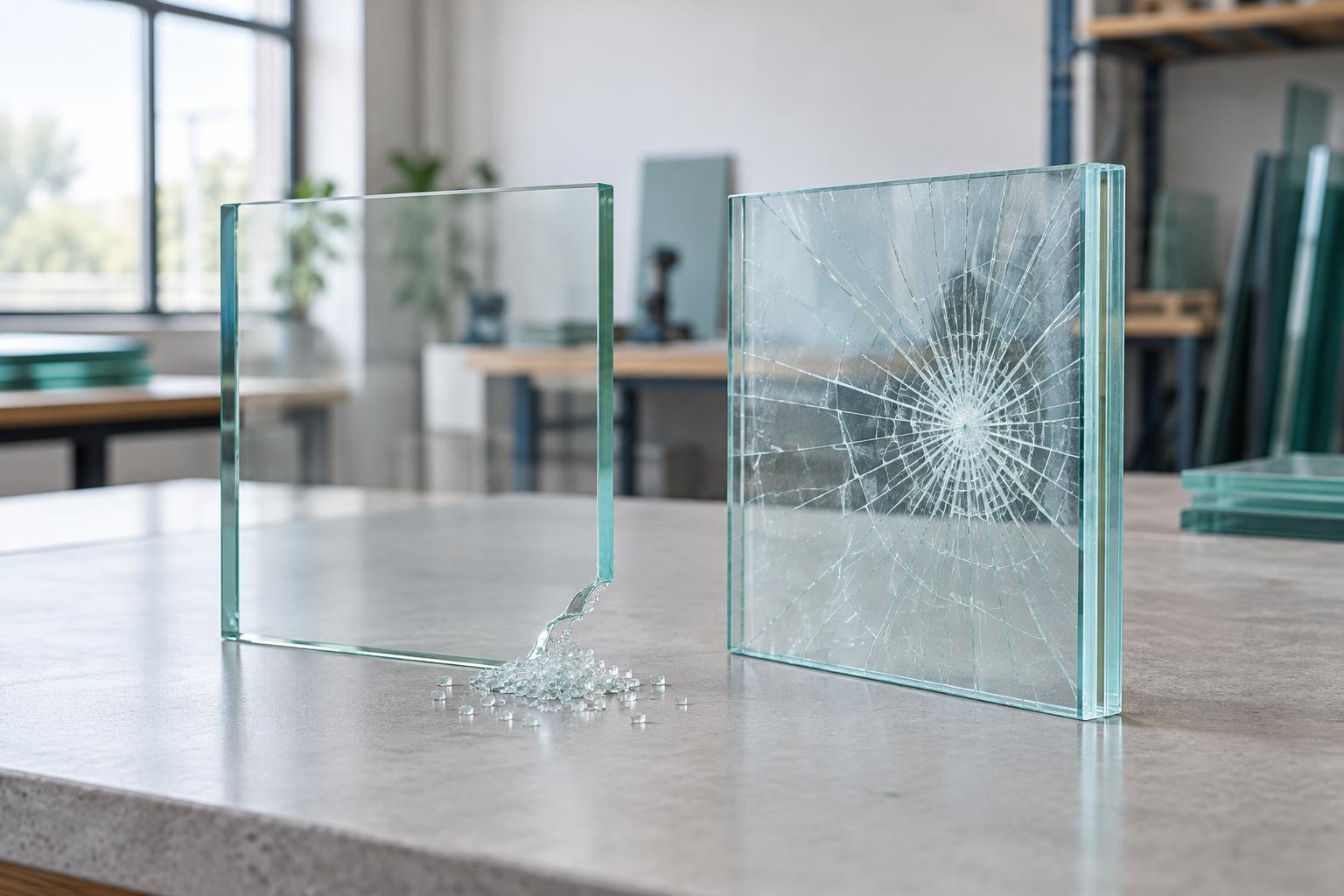
Thermal shock resistance is not the same as resistance to impact. A borosilicate cup can still break if dropped, while a soda-lime item may withstand ordinary handling well when its shape and wall thickness suit the job. Glass strength also depends heavily on surface condition: chips and scratches can provide starting points for cracks. Manufacturing controls, edge finishing and packaging therefore matter alongside composition.
Both glass families resist many everyday substances, which helps explain their use in containers. Borosilicate generally offers strong resistance to a broad range of chemical contact, making it useful in some laboratory and technical settings. But chemical compatibility is specific to the substance, concentration, temperature and duration of exposure. Neither glass should be assumed suitable for every chemical or cleaning process without checking the product’s stated limits.
What changes on the production line
Soda-lime glass is widely used for bottles and jars partly because established production systems can form it efficiently at large scale. Molten glass can be shaped in molds, and manufacturers can adjust container geometry, wall distribution and cooling to meet a product’s requirements. Borosilicate typically needs different, often higher-temperature processing conditions. That can affect equipment choice, forming methods and production cost.
The glass type also influences decisions after forming. Controlled cooling helps limit internal stresses in either material. Designers must consider how an item will be joined to other parts, whether it needs a coating or closure, and how it will be packed for transport. A material that tolerates rapid temperature changes may still need careful protection against knocks and edge damage. Recycling and disposal arrangements can also differ by product and local collection system; borosilicate should not simply be assumed compatible with every bottle-glass recycling stream.
Choosing for the job
A useful comparison starts with the conditions the finished item will face. Will it move between hot and cold environments? Is it likely to be dropped, stacked or knocked against other objects? What will touch its surface, and how will it be cleaned? For a room-temperature drinks bottle or a standard window pane, soda-lime glass is often a practical fit. For equipment that repeatedly encounters significant temperature changes, borosilicate may offer an advantage.
Then look at the product rather than relying only on a material label. Two objects made from the same glass can perform differently because of their shapes, thicknesses and treatments. Product instructions and stated temperature limits are particularly important for cookware, drinkware and technical vessels. The simplest rule is to match the glass and the design to the expected stresses: composition sets possibilities, but the finished object determines how those possibilities are put to use.