Why environmental conditions matter
Products rarely spend their entire lives at a comfortable room temperature. They may be stored in an unheated building, transported through warm weather or used in a humid space. Temperature can change how materials expand, contract, flex or bond. Humidity can affect absorbent materials, metal surfaces, coatings and electrical connections. Testing under controlled conditions helps a development team find out whether those changes interfere with the product’s intended use.
The relevant conditions depend on the product. A packaged item may need to survive storage and transport without being operated, while a powered device may also need to function during exposure. These are different questions, and a single test may not answer both. The aim is not to subject every product to the harshest imaginable environment. It is to check conditions that reasonably reflect where the product is expected to go and what it must do there.
Start with a clear test plan
A useful plan defines the sample, its condition before testing and the result that would count as acceptable. The team might check whether a latch still closes, a display remains readable, a seal stays intact or a package still protects its contents. Recording how the sample performs before exposure gives those later checks a point of comparison.
The plan should distinguish operating conditions from storage conditions and specify when checks will take place: during exposure, immediately afterward, after a return to room conditions, or at several of those points. It should also describe the temperature and humidity settings, how long samples will remain at each setting, and whether conditions will change gradually or in cycles. Where the product has several materials or components, testing an assembled product can reveal interactions that tests of individual materials might miss.
Sample preparation matters too. Packaging, protective covers, power state and orientation should match the question being tested. Otherwise, a result may reflect an unrealistic setup rather than a likely product weakness.
What happens during a chamber test
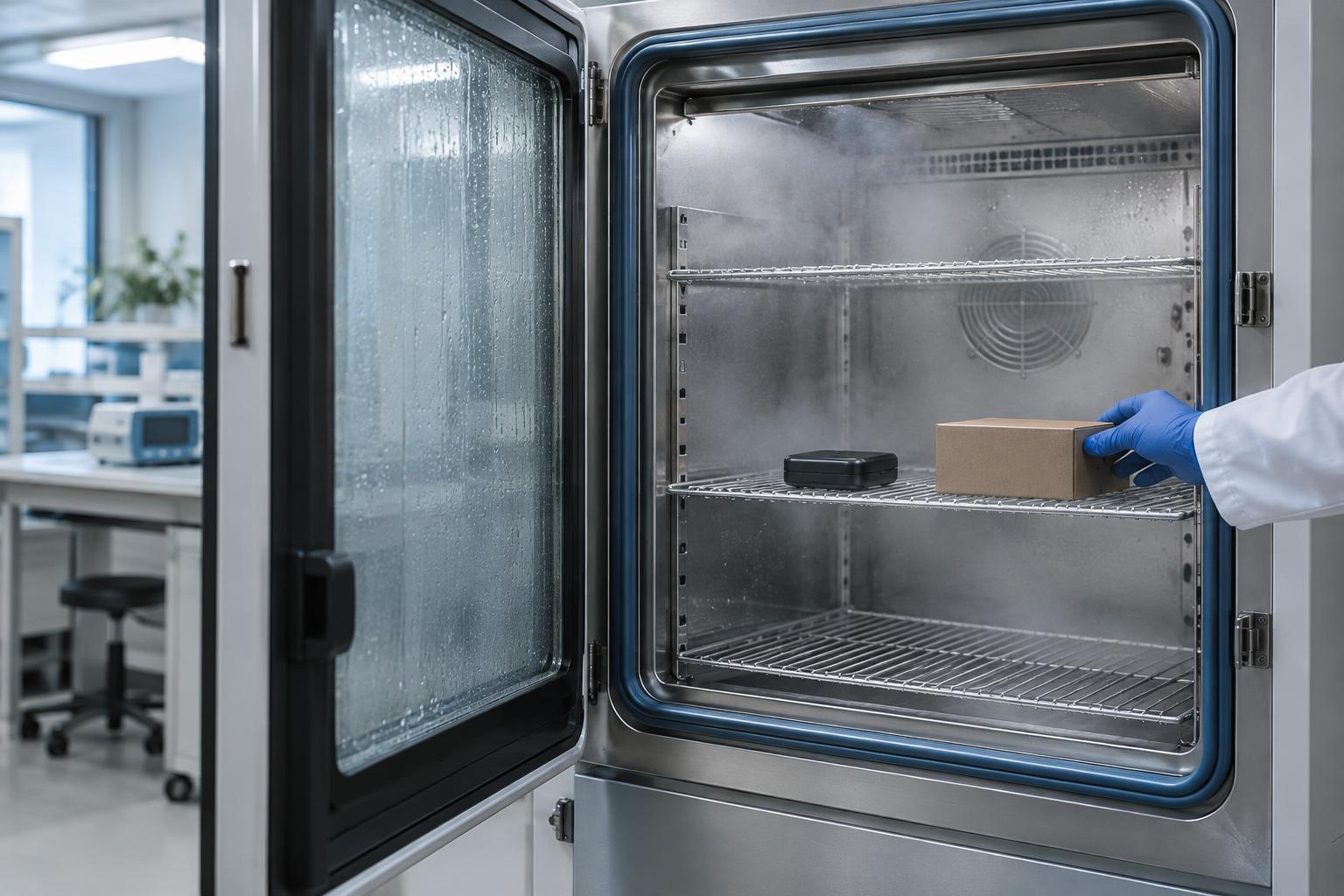
Environmental chambers allow testers to control temperature and, for suitable tests, relative humidity. Samples are placed so air can reach the areas of interest without crowding or unintended shielding. The chamber then follows the planned sequence while its conditions are recorded. If the goal is to assess performance at a particular condition, the sample needs time to respond to its surroundings; the chamber reaching its setting does not mean every part of the product has reached the same temperature.
Different sequences can expose different problems. A sustained warm, humid period may reveal swelling or changes to an adhesive bond. Repeated temperature changes may stress joints where materials expand at different rates. Moving a cold product into warmer, moist air can produce condensation, so a plan that includes such a transition may need to account for moisture on surfaces. These observations are possibilities to investigate, not proof that every product will react in the same way.
Checks during exposure can show whether a product works under the condition itself. Checks afterward can reveal damage that remains once it returns to ordinary conditions. Testers should record visible changes and functional results at the specified points rather than relying on a final pass-or-fail label alone.
Make results useful for design decisions
A failed check is most useful when the team can trace what happened. Records should connect each sample to its configuration, test sequence, observed conditions and measured results. Photographs or notes about changes such as warping, discoloration, sticking parts or corrosion can help identify where to inspect more closely. If only one sample fails, that result still deserves investigation; it may reflect a variation in materials, assembly or the test setup.
Passing a planned test does not establish that a product will perform in every climate or for any length of time. It shows that the tested samples met defined criteria under a defined sequence. Likewise, a harsh test that produces damage may have limited practical meaning if its conditions do not represent the product’s intended life. Interpreting results means comparing them with the original purpose of the test.
When testing reveals a weakness, the next step may be a design change, a material change, improved sealing, different packaging or a clearer limit on use. A follow-up test can then check whether that response addressed the problem without creating another one. In this way, temperature and humidity testing supports decisions throughout product development rather than serving only as a final inspection.