What a Shore hardness number measures
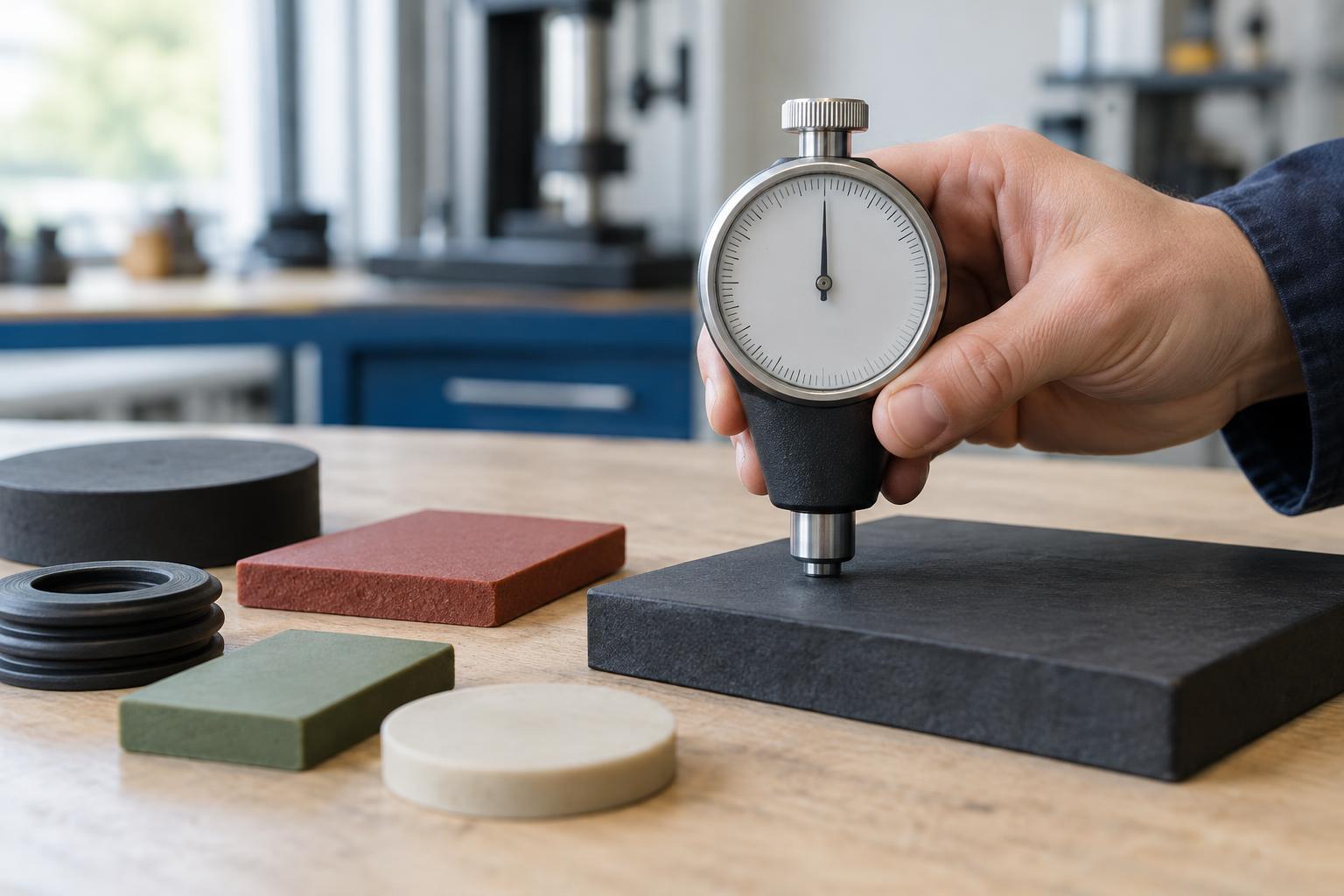
Shore hardness is a measure of resistance to indentation. A handheld or bench-mounted instrument called a durometer presses a shaped tip into a material with a defined spring force. The reading reflects how far the tip penetrates: a higher number means less indentation under that test condition. It does not measure how much force it takes to stretch, tear or permanently deform the material.
Rubber hardness is commonly reported on the Shore A scale. Softer gels and foams may be measured on Shore 00, while harder plastics and firm elastomers may be measured on Shore D. These scales use different indenters and forces, so a number without its scale is incomplete. “70 Shore A” communicates something useful; “hardness 70” leaves room for misunderstanding. Numbers on different scales should not be treated as interchangeable.
Why the same rubber can give different readings
A durometer reading depends on more than the material’s formulation. Temperature matters because many elastomers become firmer when cool and softer when warm. The time between applying the indenter and taking the reading can matter too: rubber may continue to deform while the tip is held in place. Test methods therefore specify conditions such as how and when to take a reading.
The sample also needs to provide a suitable surface beneath the indenter. A thin rubber layer bonded to a hard backing may read harder than a sufficiently thick sample of the same compound. Curved surfaces, seams, textured finishes and nearby edges can make readings less representative. When comparing supplier samples, ask whether they were measured on comparable specimens under the same scale and test conditions.
What hardness can help you decide
Shore hardness is a useful first filter when selecting materials or checking production consistency. If two rubber compounds have similar geometry and are tested the same way, the softer-rated one will generally yield more readily to the durometer tip. That may help a designer narrow candidates for a flexible grip, a protective foot or a seal that must conform to a mating surface.
A specified hardness range can also help a manufacturer check whether batches are broadly consistent. It is best treated as one property in a material specification, not a complete description of the part. A finished product’s feel depends on its shape, wall thickness, internal structure and the way a user presses or bends it. A thick part made from softer rubber can feel less flexible than a thin part made from harder rubber.
What the number cannot promise
Hardness alone does not tell you whether a rubber will last in service. Two compounds with the same Shore A rating can differ in tear resistance, abrasion resistance, rebound and resistance to oils or weathering. They may also differ in compression set: how much they fail to recover after being held compressed. For a gasket, that recovery can be as important as its initial ability to conform to a surface.
Nor does a lower hardness number automatically mean better grip or comfort. Grip depends partly on surface texture, contact conditions and the materials touching each other. Comfort depends on where pressure is applied and how the whole part deforms. Even descriptions such as “soft-touch” combine material behavior with finish and product geometry. A hardness target cannot replace testing an actual part in its intended use.
How to use a rating in a product brief
Start by naming the scale alongside the target or acceptable range, rather than specifying a bare number. If a particular test method and sample preparation are important, state those as well. Then describe the job the material must do: seal against an uneven surface, cushion an impact, resist wear or flex repeatedly. This gives a supplier a reason for the hardness target and makes it easier to discuss alternatives.
Finally, evaluate samples in a realistic part shape. Check fit and feel, then consider tests tied to the likely failure modes, such as compression recovery for a seal or tear resistance for a frequently stretched component. Shore hardness is most valuable when it helps make comparisons repeatable. It is a starting point for choosing rubber, not a shortcut to predicting every aspect of performance.