What happens during stamping?
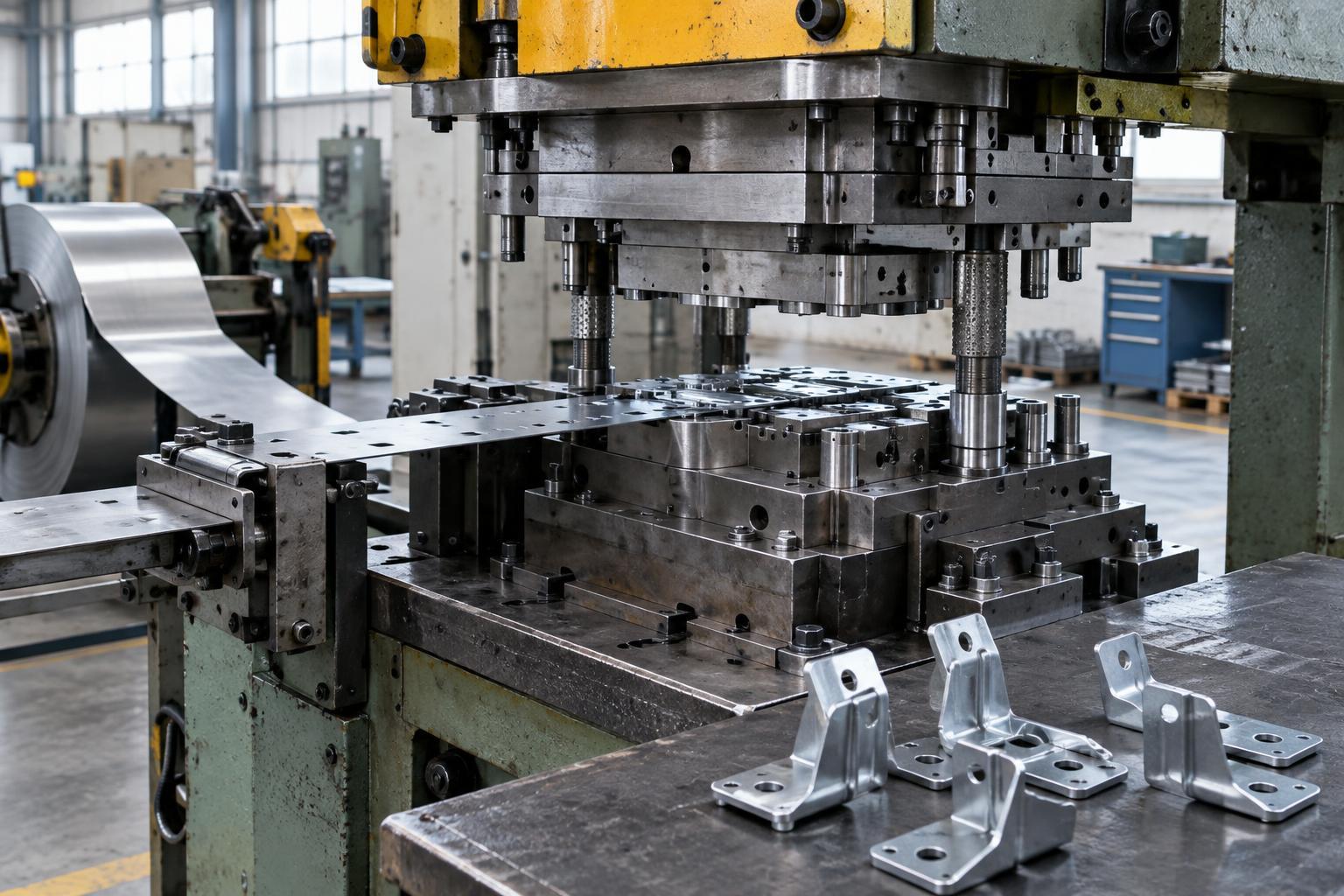
Sheet-metal stamping uses a press to force metal against a die, cutting or shaping it into a part. The starting material may be an individual sheet or a long strip fed from a coil. Depending on the part, stamping can make a simple flat bracket or a more complex shape with holes, bends and shallow formed features. It is widely used when many parts need to share the same dimensions and features.
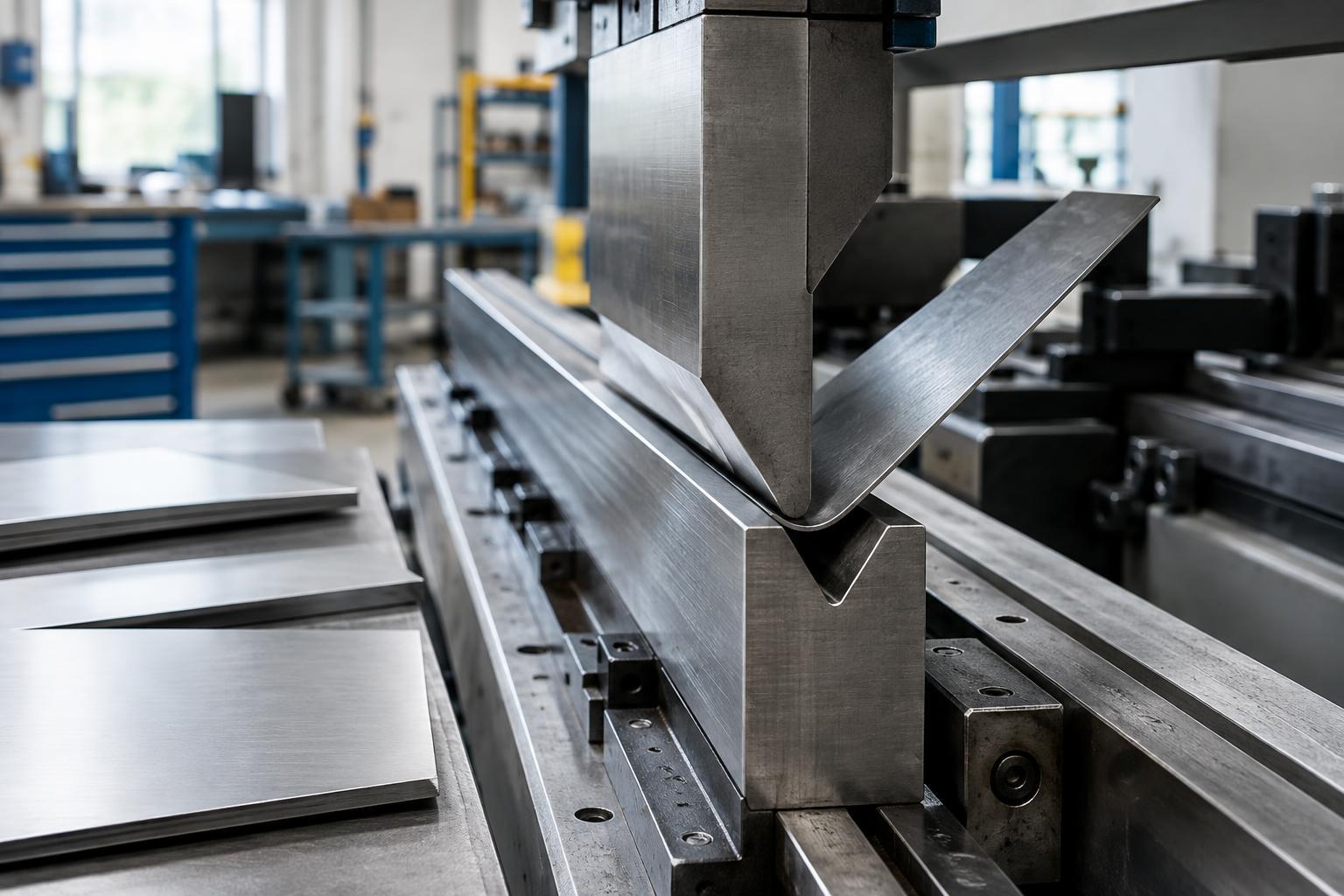
Common operations include blanking, which cuts a part’s outer shape from the stock, and piercing, which creates holes or openings. Bending changes the angle of a section, while forming produces features such as ribs or flanges. Drawing pulls material into a cavity to make a cup-like shape. A part may require several operations, either in one tool or across multiple steps.
Stamping is not automatically the best choice for every metal component. A laser cutter and press brake, for example, may be more practical for a small batch of flat parts with a few bends. Stamping becomes more attractive when repeatability and production speed can justify the time and expense of designing dedicated tooling.
The die determines the part’s shape
A die is the tooling mounted in the press. Its working surfaces guide where the metal is cut or formed, while features such as guides and stops help position the stock. In a cutting operation, a punch pushes material through an opening in the die. The gap between those edges, called clearance, affects the cut edge and tool wear. Toolmakers select it with the material and sheet thickness in mind.
Different die layouts suit different parts and workflows. A single-operation die performs one task per press stroke. A compound die can perform multiple cutting operations at one station. In a progressive die, a strip advances through a sequence of stations, gaining features at each stop until a finished part is separated. Transfer tooling instead moves individual workpieces between stations, which can be useful when a part is no longer conveniently carried by a continuous strip.
Die design also accounts for how the part leaves the tool, how scrap is removed and how the metal behaves after forming. Metal can spring back slightly when forming pressure is released, so the tool and process may need adjustment to achieve the intended angle. A well-designed die supports consistent output, but it still needs setup, maintenance and inspection.
What does the press contribute?
The press supplies the force and motion that bring the die components together. Its capacity must be appropriate for the work: cutting thick or strong material generally requires more force than cutting a thinner or softer sheet of the same shape. Stroke length, working area, operating speed and the point in the stroke where force is available also matter. Press selection is therefore about more than choosing a machine with a large force rating.
Mechanical presses use a motor-driven mechanism to move the slide through a set stroke. They can suit repetitive work at a consistent pace. Hydraulic presses use fluid pressure to move the slide and can offer flexible control over the stroke, often at a slower pace. Servo presses use a controlled motor to vary slide motion, which may help with certain forming tasks. No press type is universally better; the part, tooling and target output determine the useful combination.
Feeding and handling equipment affect the overall process as much as the press itself. Coil-fed production needs controlled strip movement between strokes. Operators must also be protected from moving tooling and sharp stock, so guarding and safe setup procedures are essential parts of a production plan.
Why production volume changes the calculation
A stamping die is a substantial upfront commitment. It must be designed, built, tested and sometimes revised before routine production begins. Once it is working well, however, the same tool can produce parts repeatedly with relatively little cutting or forming time per part. Higher production volume gives more parts over which to spread the tooling cost.
For a prototype or short run, flexible methods may be preferable even if each part takes longer to make. They can also make design changes easier while hole positions, bend locations or other details are still being decided. At larger volumes, dedicated stamping tooling can become appealing, particularly when several operations can be combined into a smooth sequence. The crossover point depends on the part’s geometry, material, required finish, tooling complexity and available equipment; there is no universal batch size at which stamping becomes economical.
Material use belongs in this calculation too. The shapes cut from a strip leave behind scrap, and their arrangement affects how much stock is consumed. A tool layout that improves material use may require a different die design or feeding arrangement. Comparing processes means considering the complete route to an acceptable part, not just the speed of one press stroke.
Design and quality questions to ask early
Small design choices can influence how readily a part stamps. Very tight bends, narrow webs between holes and edges, or features close to a bend may complicate tooling or increase the risk of distortion. Sheet thickness, material grade and the direction of the material’s grain can also affect forming. Discussing these details before the die is built is usually easier than modifying hardened tooling later.
A practical inspection plan focuses on features that affect fit and function, such as hole locations, outside dimensions, bend angles and formed depths. Cut edges may have burrs, and formed surfaces may show marks from tooling or handling. Requirements for edge condition and appearance should be clear rather than left to assumption. During production, tool wear and changes in feeding or lubrication can alter results, so checks should continue after the first approved parts.
The simplest way to understand stamping is as a matched system: the material, die, press, feeding method and inspection approach must work together. The best setup is not necessarily the fastest one. It is the one that can make the required part consistently at a sensible cost for the expected volume.