Shaping metal with pressure
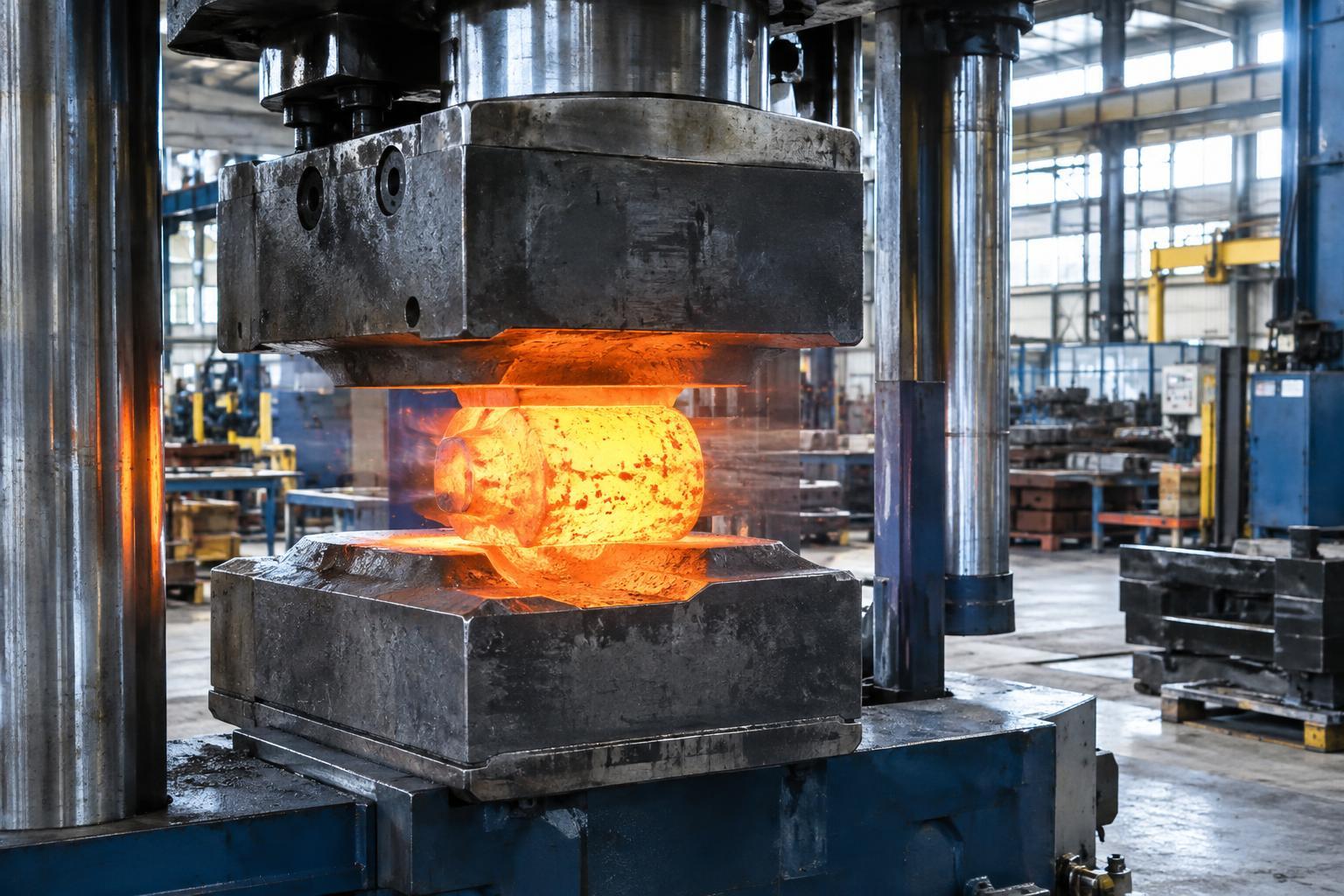
Forging shapes metal by pressing, hammering or squeezing it into a new form. Unlike casting, which pours liquid metal into a mold, forging starts with solid metal. The workpiece may be heated until it is easier to deform, but it remains solid as force changes its shape. A simple example is a bar compressed between flat tools; more complex parts are formed between shaped dies.
The basic sequence is to prepare a piece of stock, position it in the equipment and apply force in one or more steps. Depending on the part, the forger may then trim excess material, straighten the shape, heat-treat it or machine surfaces that need precise dimensions. Forging produces useful features, but it rarely creates every detail of a finished component in one operation.
Open dies, closed dies and temperature
In open-die forging, the tools do not fully enclose the metal. An operator or automated system moves the workpiece between presses or hammer blows to build up its shape. This approach can suit large, relatively simple forms. In closed-die forging, shaped tool cavities guide the metal toward a more defined part geometry. Some material may squeeze out at the die edges as flash, which is later removed. Both methods require allowances for how the metal will flow.
Forging temperature changes the demands of the process. Hot forging makes metal easier to deform and supports substantial shape changes, but the part can develop surface scale and may need more finishing. Cold forging is done without first heating the workpiece to hot-forging temperatures. It can offer good surface finish and dimensional control, although it takes greater force and the metal may become harder to deform as it is worked. Warm forging falls between these approaches. The right choice depends on the alloy, shape, production quantity and required properties.
Why a forged part can be strong
Metal has an internal structure made up of grains. During forging, those grains and other features of the structure change as the metal deforms. The resulting grain flow can follow the contours of a part rather than being interrupted by cutting a shape from a larger block. In a well-designed component, that flow can be beneficial where loads repeatedly act along a known path.
Compression during forging can also close some internal voids in suitable starting material. Compared with a poorly made casting, for example, a sound forging may have fewer internal defects that could start a crack. That comparison is not a promise: a casting made to the right specification can perform well, and forging cannot fix every defect in its starting material. Strength also has several meanings. Resistance to breaking, repeated loading, impact and permanent bending do not always improve together.
Cold forging may raise strength through work hardening, while hot-forged parts often rely on subsequent heat treatment to reach their specified properties. Alloy selection, temperature control, amount of deformation and cooling history all matter. A part is not strong merely because it has been forged; its properties must suit the forces and conditions it will encounter.
Designing for metal flow
A useful forging design gives the metal a practical route into the required shape. Sudden changes in thickness, very sharp corners and deep narrow features can make filling a die difficult or concentrate stress in the finished part. Designers often use generous transitions and leave material where later machining will create accurate holes, threads or mating surfaces. The orientation of the starting stock and the direction of forming also matter when grain flow is important.
Tooling is another trade-off. Shaped dies take time and expense to make but can produce many similar near-net-shape parts, reducing some later cutting. Open-die work offers flexibility for simpler or larger pieces, though it may leave more machining to do. When comparing processes, it helps to consider the whole route from raw stock to finished component, including material waste, tool life and inspection—not just the forging step.
What inspection still needs to confirm
Forged parts can have problems such as incomplete die filling, folds where metal overlaps, surface cracking or dimensions outside tolerance. Inspection may include visual and dimensional checks, mechanical tests on representative material, and methods that look for flaws below the surface. The appropriate checks depend on the part and its intended use.
Forging is valuable because it combines shaping with control over a metal part’s internal structure. Its strongest case is not that it makes every part stronger by default, but that the process can be planned around a component’s geometry and loads. Sound material, suitable tooling and verified properties are what turn that potential into a dependable finished part.