What sand casting does
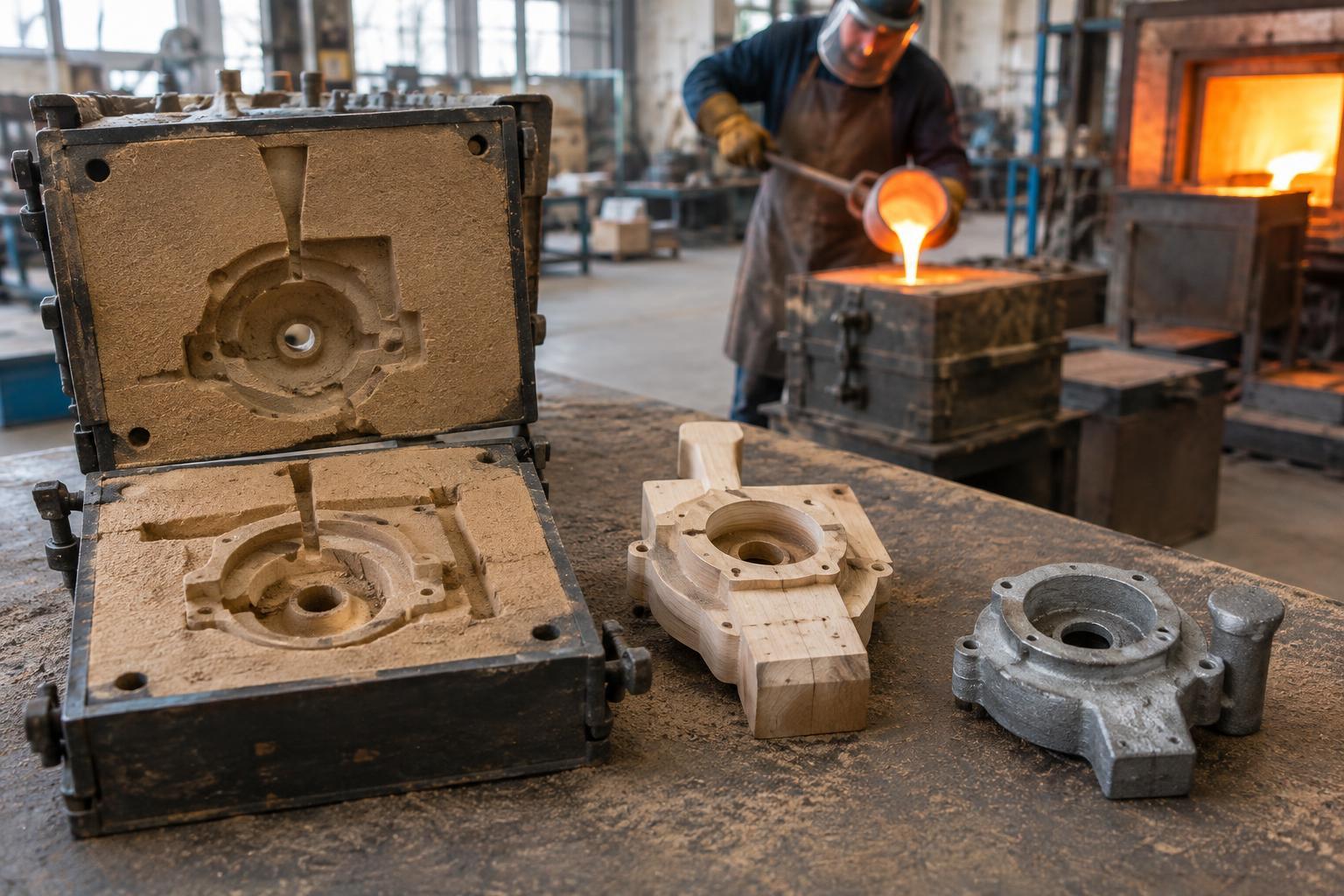
Sand casting makes a metal part by pouring molten metal into a cavity formed in a sand mold. After the metal solidifies, the mold is broken apart to remove the casting. Because the mold is used only once, a new mold must be prepared for each pour, even when the same pattern is used repeatedly.
The process can produce shapes that would be difficult to cut from a solid block, including parts with curved surfaces and internal passages. It is often considered for housings, brackets and other components where the required size, shape and production volume suit a sand mold. The result of pouring is not usually a ready-to-use part: it may still need cleaning, inspection and machining.
Start with a pattern designed for removal
A pattern is the model used to form the mold cavity. It resembles the intended part but is not necessarily an exact copy. Designers may add a shrinkage allowance because metal contracts as it cools, and a machining allowance where material will later be cut away to reach a required dimension or finish. Slightly tapered surfaces, known as draft, help the pattern come out of the packed sand without tearing the cavity.
Many molds are made in two halves. The line where they meet is the parting line, and its position affects how easily the pattern can be withdrawn and how much cleanup the casting may need. A pattern may also include features that help locate a core: a separately made shape placed inside the mold to create a hole or internal passage. These decisions are part of casting design, not merely preparations made after the part has been designed.
Build the sand mold and its flow paths
To make a mold, workers or equipment pack molding sand around the pattern in a supporting frame. The sand must hold the cavity’s shape while allowing the mold to be assembled and filled. Different molding methods use different sand mixtures and binders, chosen in part for the metal, geometry and production setup. Once the pattern is removed, any required cores are placed, and the mold halves are brought together.
The mold also needs a way to deliver metal to the cavity. A pouring opening, channels and entrances called gates guide the flow. Risers are reservoirs of metal connected to areas that need feeding as the casting solidifies and contracts. Poorly planned flow or feeding can leave defects such as unfilled sections, trapped material or shrinkage cavities. The layout must therefore account for more than the visible shape of the final part.
Pour, cool and break out the casting
The selected metal is melted and poured into the prepared mold under controlled conditions. It travels through the flow paths, fills the cavity and begins to lose heat to the surrounding sand. Pouring too slowly, too quickly or at an unsuitable temperature can affect how completely the cavity fills and the quality of the result; the appropriate conditions depend on the alloy and the part.
The casting stays in the mold while it solidifies and cools enough for removal. Timing matters because different areas of a part may cool at different rates, particularly where wall thickness changes. Once it is ready, the mold is opened or broken apart and the casting is separated from the sand. At this point, attached gates and risers remain as extra metal rather than useful features of the part.
Clean, check and finish the part
Cleanup, often called fettling, removes the gates, risers and unwanted metal along mold joints. The surface may be cleaned to remove adhering sand, and selected faces or holes may be machined where tighter dimensions or a smoother finish are required. Sand casting naturally tends to leave a rougher surface than processes that use a smooth permanent mold, so the specified finish should match the part’s purpose.
Inspection checks whether the casting meets its requirements. Depending on the part, that may mean measuring key dimensions, looking for visible surface defects or using additional tests to examine areas that cannot be seen from outside. A rejected casting is not always evidence of a single pouring mistake: pattern design, mold preparation, cores, metal flow and cooling can all influence the outcome.
The central idea is straightforward: a pattern defines the cavity, sand holds that shape, and molten metal takes its place. Making a reliable part depends on coordinating every stage, including the allowances and finishing work that are easy to overlook when viewing only the finished casting.