A continuous way to shape plastic
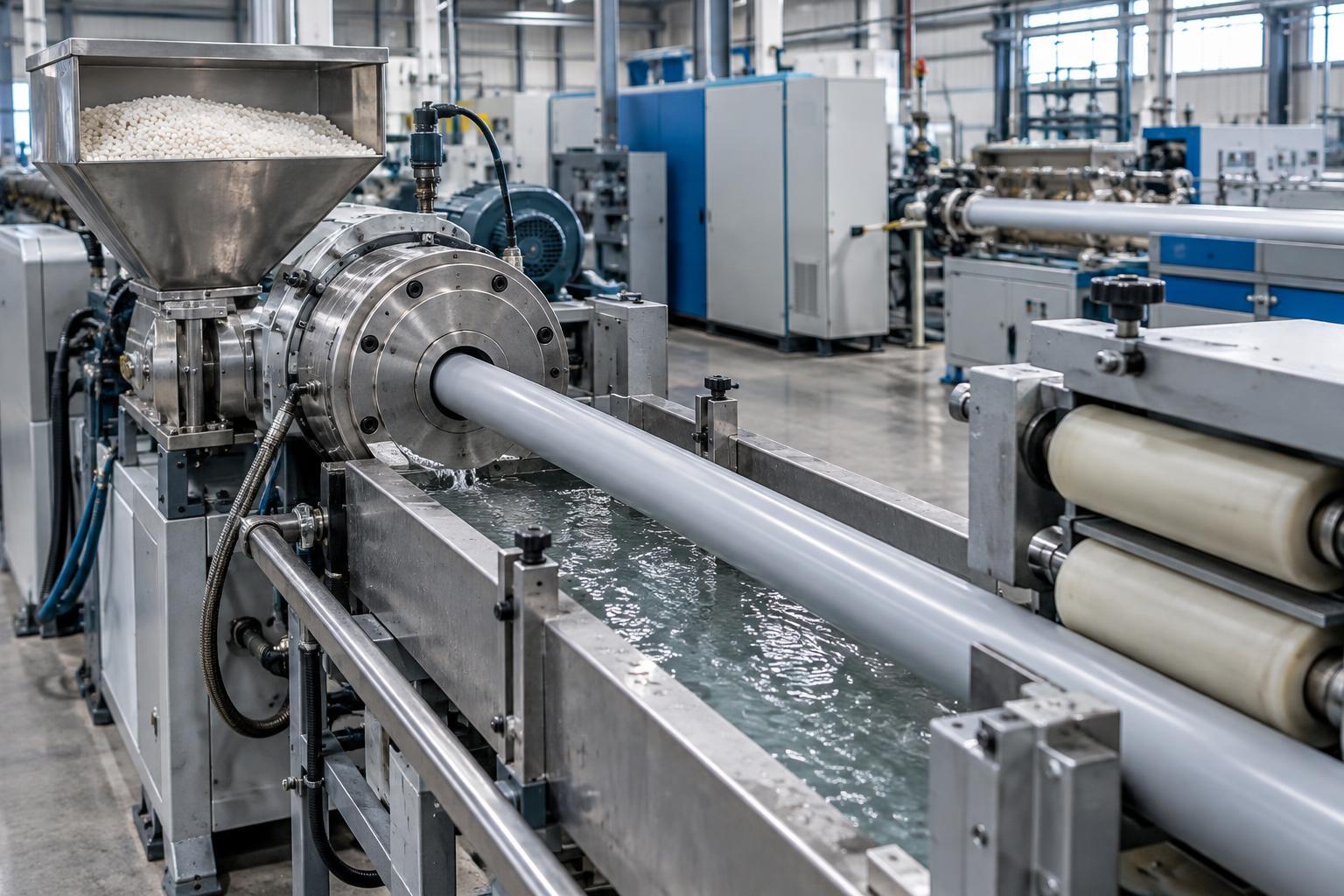
Plastic extrusion makes products with a consistent cross-section along their length. Pellets enter a heated barrel, where a rotating screw moves, mixes and melts them. The molten plastic is pushed through a shaped opening called a die. As it leaves the die, downstream equipment cools and supports it, then pulls it forward for cutting or winding. Unlike injection molding, which fills a closed mold to make individual parts, extrusion can keep producing material as long as the line is supplied and running.
That continuous approach suits pipes, flat sheets and profiles such as channels or edging. Their cross-sections can be quite different, but they share a central challenge: hot plastic changes shape easily. A successful line must coordinate melt flow, die design, cooling and pulling so the product keeps the intended dimensions after it solidifies.
From pellets to a steady melt
The process starts with a material chosen for the product’s job. Different plastics offer different combinations of stiffness, flexibility, chemical resistance, appearance and processing behavior. Pellets may also be combined with colorants or other additives. The feed material needs to be prepared consistently; depending on the plastic, that can include controlling moisture before it enters the hopper.
Inside the barrel, the screw carries material forward while heat from the barrel and mechanical work soften it. The aim is a reasonably uniform melt delivered at a steady rate. Temperature settings cannot simply be turned up to make every material flow faster: excessive heat or time in the barrel can damage some plastics, while insufficient melting can leave defects. Screens or filtration may be used ahead of the die to catch unwanted particles, though they also add resistance to flow.
Why pipes, sheets and profiles need different tooling
The die gives the melt its initial shape, but the opening is not always an exact copy of the finished product. Plastic can expand slightly as it exits, then shrink as it cools; pulling can also stretch it. Tooling and line settings account for these effects. For pipe, the melt flows around a central part of the die to form a hollow tube. Calibration and cooling equipment then help set its outer diameter and wall shape. Uneven flow or cooling can contribute to wall-thickness variation or distortion.
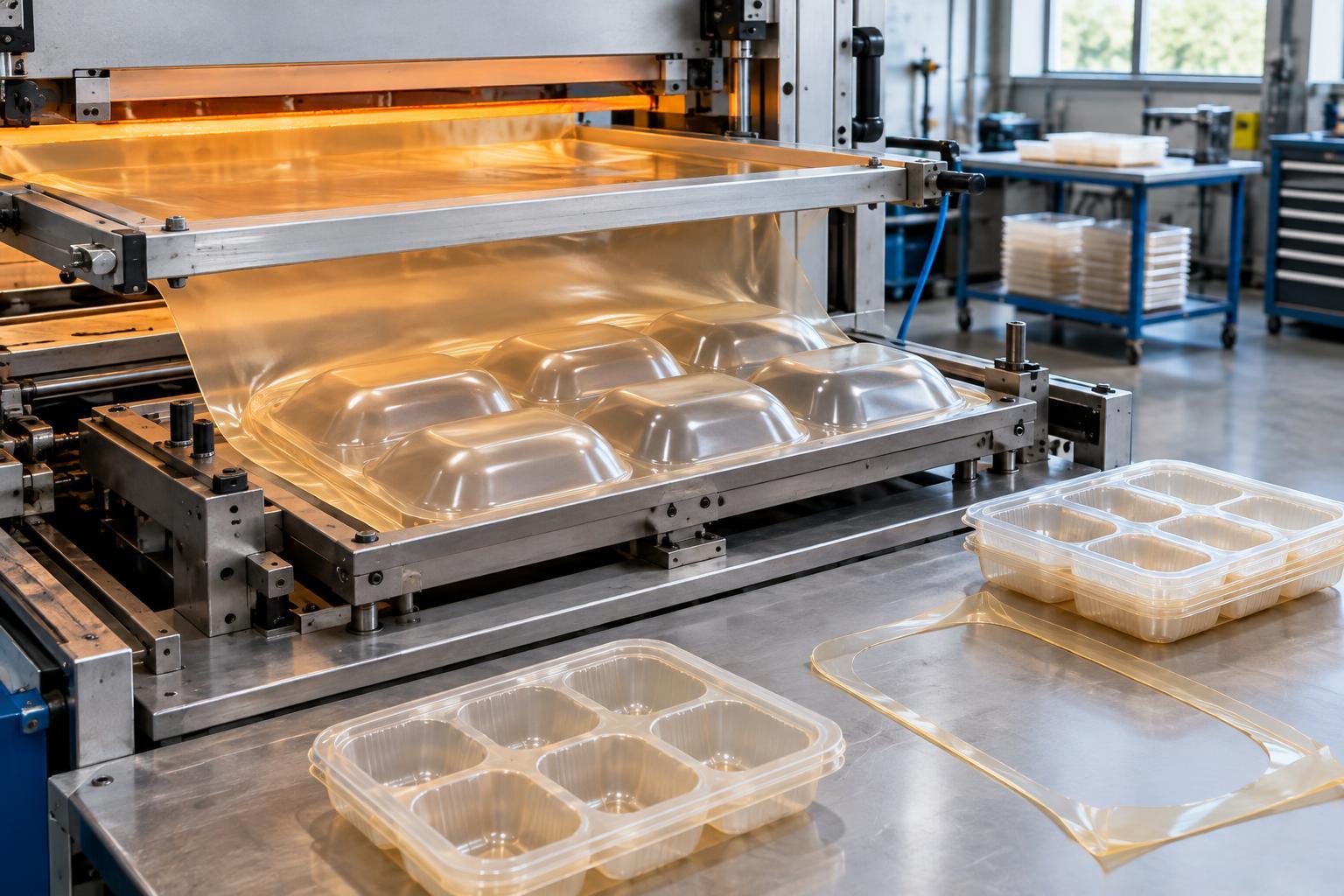
Sheet extrusion uses a wide die to spread the melt into a flat band. Rolls can cool the sheet and help set its thickness and surface finish before it is trimmed, cut or wound. Profiles use dies with openings shaped for features such as lips, grooves or multiple walls. These details can be harder to cool evenly than a simple flat shape, so a profile may need guides or calibration tools to hold its geometry while it firms up.
Cooling and pulling complete the shape
Leaving the die is only part of forming the product. Cooling must remove enough heat for the plastic to hold its shape without introducing unwanted warping. Water tanks, air and cooled rolls are among the methods used, depending on the product. Cooling that is uneven or too abrupt for a particular shape can leave stresses or visible defects. Thick sections generally need more time to cool through than thin ones.
A haul-off unit pulls the product along the line. Its speed has to match the amount of melt arriving from the extruder: pulling faster may reduce dimensions, while pulling too slowly may leave excess material or an unstable shape. Once the product is sufficiently cool, a cutter can make set lengths. Flexible products or thin sheet may instead be wound into rolls, provided they can be wound without damage.
What operators check and where extrusion fits
Operators monitor both the line and the finished output. Useful checks include pipe diameter and wall thickness, sheet thickness across its width, profile dimensions, surface appearance and straightness where relevant. A defect may have several possible causes. For example, inconsistent dimensions could involve feed, melt delivery, cooling or haul-off speed. Changing one setting at a time and checking the result helps identify the cause without creating a new problem elsewhere.
Extrusion is a good fit when a product needs a long, repeatable cross-section. It is less suited to a single-piece shape that changes dramatically along its length or needs complex enclosed details. Even for a simple pipe or sheet, making a reliable product involves more than choosing a die: material, tooling and downstream equipment must work together. Understanding that full sequence makes it easier to see why two products made from similar plastic can require very different extrusion lines.