What rotational molding does differently
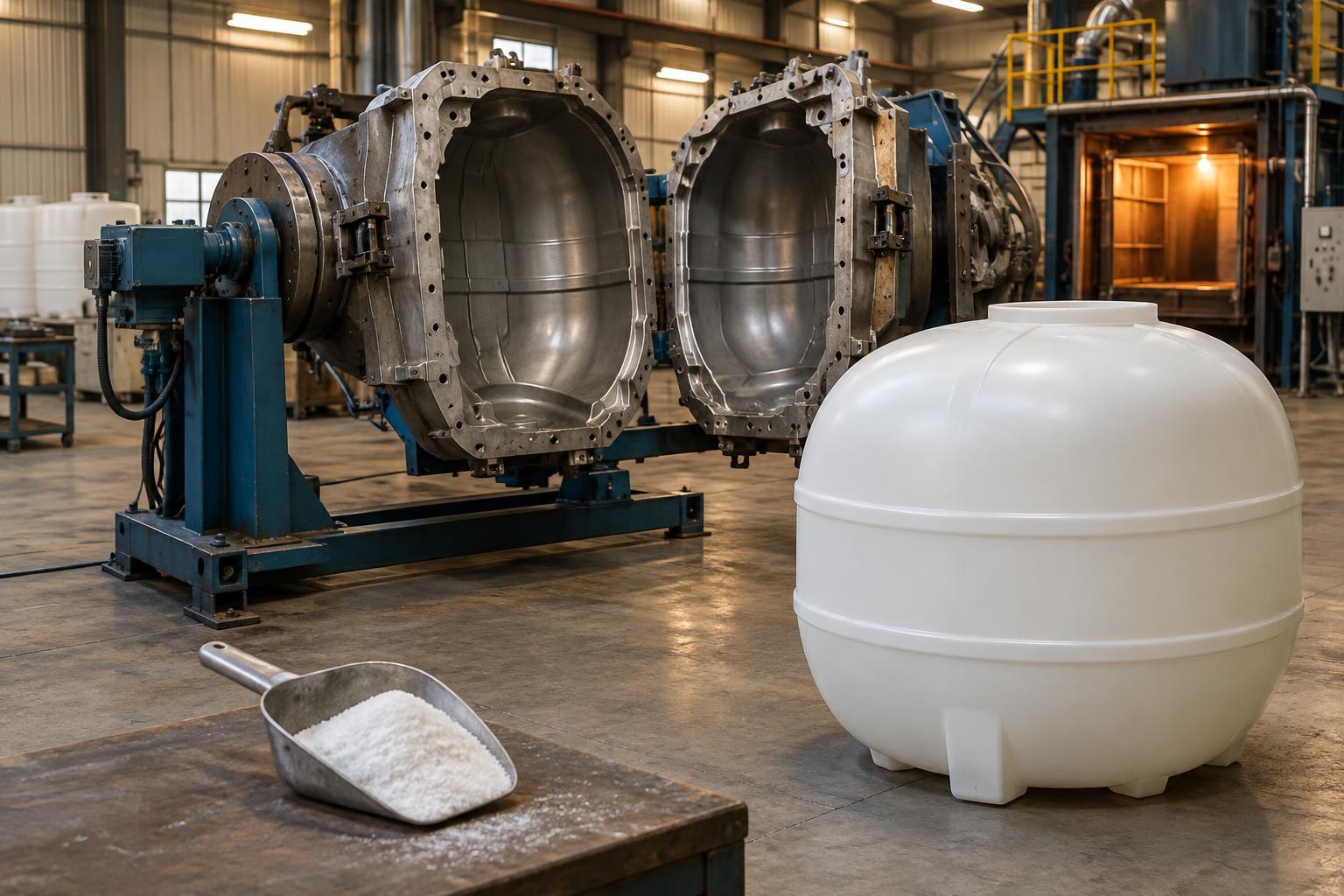
Rotational molding, often called rotomolding, makes hollow plastic parts by placing a measured amount of material inside a closed mold. The mold is heated while turning around two axes. As the plastic softens, it coats the interior surfaces. The mold then cools while continuing to turn, and the finished part is removed.
Unlike blow molding, which inflates a softened tube or preform against a mold, rotational molding does not depend on high internal pressure to shape the plastic. This makes it useful for some large, seamless objects such as storage tanks, playground components and equipment housings. It also means the process has its own limits: walls may vary in thickness, cycles can be relatively long, and fine details require careful design.
From measured powder to finished part
Production begins with a mold that can be opened, filled and securely closed. A measured charge of plastic, commonly in powder form, is placed inside. The amount matters because it largely determines how much material is available to form the walls. Too little can leave thin areas; too much adds weight and cost and may interfere with the intended shape.
The closed mold enters a heated chamber and rotates slowly on two axes. The plastic warms, adheres to the mold’s inner surface and gradually forms a continuous layer. Rotation is not meant to fling the material outward like a centrifuge. Its purpose is to repeatedly bring material into contact with different areas as it melts and spreads.
After heating, the mold moves into a cooling stage, often using moving air or a controlled water spray. Rotation continues so the still-soft part keeps its shape as it solidifies. Workers then open the mold, remove the part and trim material at openings or mold seams where needed. The part may also receive fittings, inspection or other finishing work.
Why product designers choose it
A major attraction is the ability to make a hollow item as one molded piece rather than joining separate shells. Fewer joints can simplify assembly and remove potential leak paths, although openings, fittings and seals still need appropriate design. Rotational molding can also produce broad curves and rounded corners that suit both appearance and handling.
Tooling can be relatively straightforward compared with molds built to withstand high injection pressures. That may make the process appealing when a product is physically large or demand does not justify more complex tooling. The full production cost still depends on cycle time, material use, finishing and the number of parts required. For a look at the everyday routines in which containers and other household products are used, browse Home Cooking · Everyday Japanese Table for home-cooking ideas.
Designing for consistent walls and usable features
A mold must allow molten plastic to reach and coat its intended surfaces. Deep, narrow recesses and tightly spaced walls can be difficult to fill evenly, while broad transitions are generally easier to form. Designers often favor generous radii rather than sharp corners, which can be harder to coat consistently. Material choice, mold temperature and the heating schedule also affect how well the plastic flows and fuses.
Rotational molding usually leaves a hollow interior, so features such as threads, handles and mounting points deserve early attention. Some can be molded in; others may require inserts or later assembly. Openings must be positioned so the part can be molded, removed and finished. A tank, for example, also needs support and fittings suited to its intended contents and installation—not merely a shape that looks right on a drawing.
The trade-offs to check before choosing the process
Rotational molding is not a universal route to hollow plastic products. Its heating and cooling stages can make each cycle lengthy compared with some other molding methods. Wall thickness and final dimensions may need wider allowances than a design with tight precision requirements can accept. Not every plastic is equally suited to the process, so a material should be selected with the intended shape and performance in mind.
A practical evaluation starts with a few questions: How large is the part? Does it benefit from one-piece construction? What wall thickness variation is acceptable? Where will openings, seams and mounting points go? Answering these questions alongside expected production volume helps reveal whether rotational molding’s freedom to make large hollow shapes outweighs its slower cycles and finishing needs.