From metal powder to a solid component
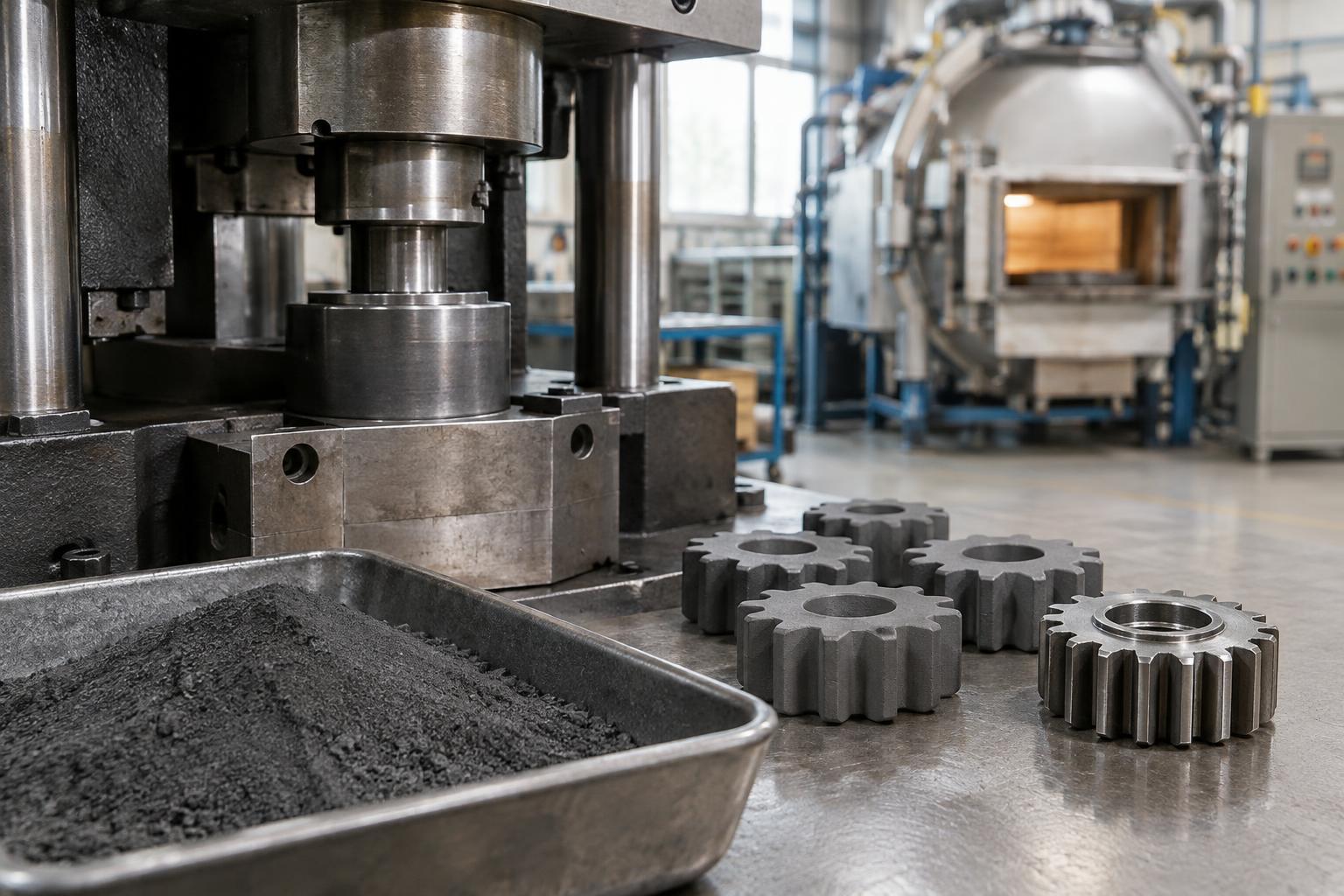
Powder metallurgy is a family of manufacturing methods that starts with metal in powder form rather than a solid bar or molten charge. In a common press-and-sinter process, a measured quantity of powder is placed in a die, compressed into a recognizable shape, and then heated in a controlled furnace. The result can be a near-final component that needs little additional shaping.
This route is useful for making repeated parts with features that can be formed by pressing, such as certain gears, bushings and structural fittings. It can reduce the amount of metal removed as scrap compared with machining the same shape from a solid piece. That advantage depends on the part: tooling, production volume, material choice and finishing requirements all affect whether powder metallurgy is the practical option.
Preparing and pressing the powder
Production begins with a powder selected for the required composition and particle characteristics. A powder may contain more than one metal, and small amounts of lubricant may be blended in to help it flow into the die and release after pressing. Consistent mixing matters because differences in composition or powder fill can lead to differences between finished parts.
During pressing, punches apply substantial pressure to powder held in a rigid die. The particles move closer together and grip one another, creating a compact that can be handled carefully. At this stage, often called a green compact, the part has its basic shape but is not yet strong enough for its intended service.
Pressure does not always spread evenly through a complex shape. Tall, thin sections or abrupt changes in thickness can make uniform compaction difficult. Features that require a punch to move sideways, including some undercuts and cross-holes, may be impractical to form in a simple pressing operation. Designers therefore often favor shapes that can be pressed and ejected along a clear direction.
What happens during sintering
The compact travels through a furnace with controlled temperature, time and atmosphere. In conventional press-and-sinter production, the furnace heats the metal below the melting point of its main constituent. Contact points between particles develop into stronger bonds, and the compact gains strength. Some lubricants are removed during heating, so the furnace cycle must account for both their removal and the subsequent bonding stage.
Sintering typically changes the part’s dimensions as well as its strength. The amount of change depends on factors including powder composition, compact density and the heating cycle. Manufacturers account for this when designing tooling and checking finished dimensions. A controlled furnace atmosphere also helps limit unwanted reactions, such as excessive oxidation, that could interfere with bonding or surface quality.
Spaces can remain between particles after sintering. This residual porosity distinguishes many press-and-sinter parts from fully dense wrought metal and can influence strength, fatigue performance and the ability to hold liquids. It can also be useful: pores in some bearing materials can hold lubricant. Porosity is therefore a property to manage, not simply a defect to eliminate.
Finishing and checking the part
A sintered part may be ready for use, but some components go through further operations. Sizing presses can improve dimensional consistency; machining can add features that were difficult to press; and heat treatment or surface finishing may be used where the material and application call for them. Each extra step adds time and cost, so a good design weighs the benefit of a feature against the work needed to make it.
Quality checks depend on what the part must do. Manufacturers may examine dimensions, density, surface condition and mechanical properties using methods suited to the component. A part that looks sound externally may still have a density variation that affects its performance. Clear specifications should therefore cover functional needs, not just overall shape.
When press-and-sinter is a good fit
Press-and-sinter manufacturing is often attractive when many similar parts are needed and the shape can be made reliably in a die. Its ability to produce near-final shapes can limit machining, while controlled powder blends offer ways to tailor material composition. The best candidates make good use of those benefits without demanding extensive secondary work.
It is less suited to every geometry or loading condition. A design requiring very large size, intricate side features or consistently high density throughout may call for a different process or a different powder-metallurgy method. When comparing options, consider the complete route from powder preparation through pressing, sintering, finishing and inspection. The key question is not whether a part can be pressed, but whether the finished part can meet its requirements consistently and economically.