Start with how each process removes material
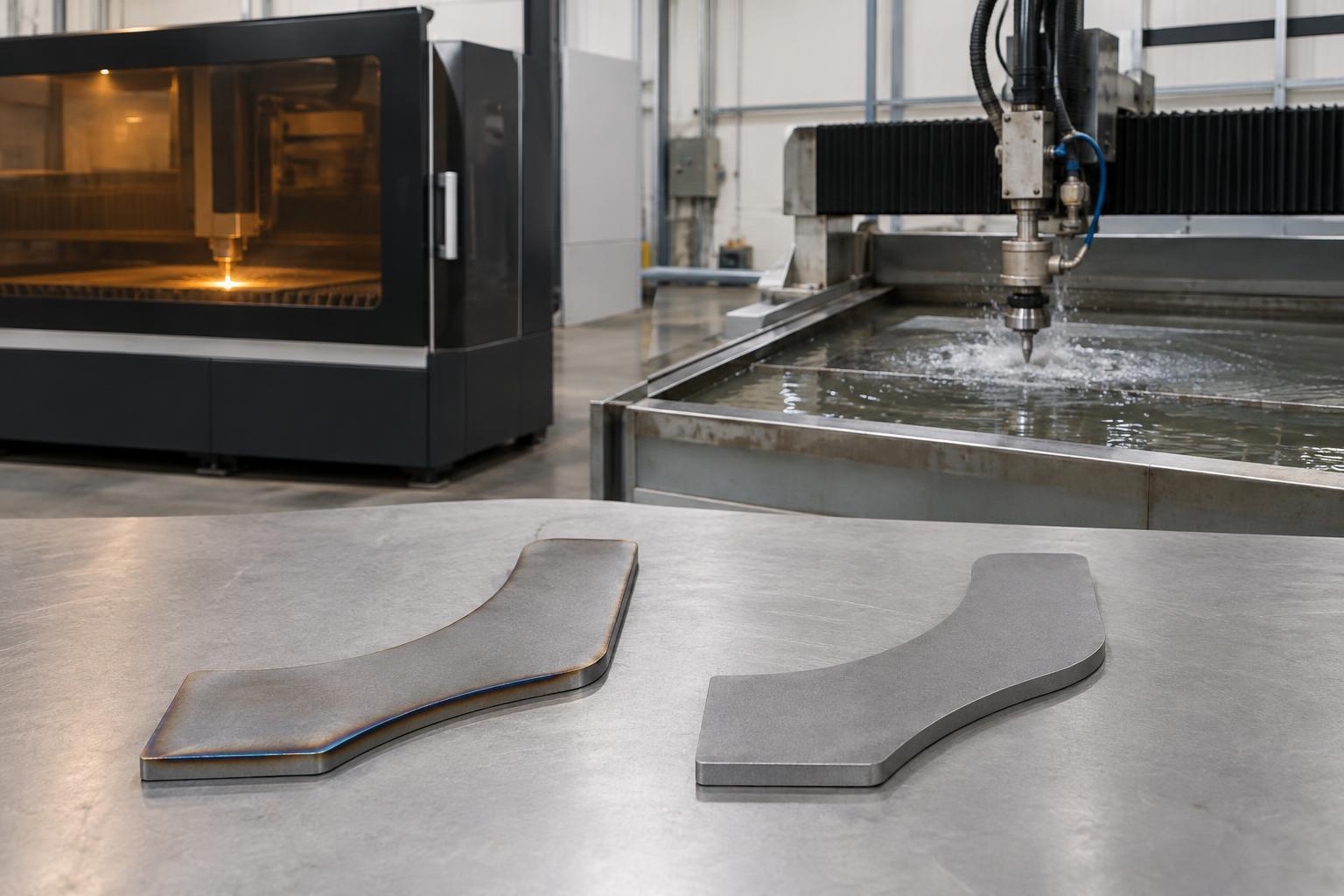
Laser cutting uses a focused beam to heat material along a programmed path. Depending on the material and setup, the beam melts, burns or vaporizes a narrow region, while a gas may help clear material from the cut. The process is often well suited to repeatable profiles in sheet material, especially when a shop already has equipment configured for that material and thickness.
Waterjet cutting uses a high-pressure stream of water. For harder materials such as metal or stone, abrasive particles are usually added to help erode the cut. Because it does not rely on heating the workpiece to separate it, waterjet is often considered when heat could change the material, damage a coating or affect a later operation. Neither process is automatically the better choice: the material, part geometry and required edge condition matter more than the process name.
Match the method to the material
For many thin metal sheets, laser cutting is a useful first option. It can create detailed shapes and small features efficiently, provided the chosen machine can cut the alloy and thickness. As thickness increases, cutting speed, edge quality and machine capability become more important questions. Some reflective metals also need equipment and settings suited to their behavior; it is better to ask a supplier about a specific alloy than to assume every laser can cut it equally well.
Waterjet cutting is versatile across a wide range of metals and can be attractive for thick stock or parts that must avoid a heat-affected zone. It also handles many materials that are awkward to cut with heat, including stone and certain composites. With layered materials, however, the force of the jet may create a risk of delamination, so a sample cut is worthwhile.
Plastics, rubber, wood and other nonmetals require material-by-material judgment. A laser may leave a clean-looking edge on one plastic but melt, discolor or produce hazardous fumes from another. Waterjet avoids thermal damage but leaves the part wet and may introduce abrasive. For any unfamiliar material, confirm that the shop can process it safely and inspect a trial piece before committing to a run.
Look beyond the outline of the cut
A drawing may show only a profile, but the cutting process also affects the edge and nearby material. Laser cutting can leave a heat-affected zone, discoloration, burrs or adhered material, depending on the setup. Those effects may matter if the part will be welded, coated, bent or left with a visible edge. Waterjet avoids laser-related heat effects, but its edges can show striations, and the cut can taper from top to bottom. Slower cutting or process adjustments may improve an edge, though they can add time.
Accuracy should be discussed in terms of the actual feature, not a general claim that one process is more precise. A small hole, narrow slot or closely spaced internal corner may behave differently from a long outside contour. Material thickness, machine condition and operator settings all influence the result. Identify the dimensions that truly matter on the drawing, then ask what tolerance the supplier can reliably hold for those features. If an edge must seal, slide against another part or have a particular appearance, specify that requirement as well.
Account for handling, finishing and total effort
Cutting time is only part of production. Laser-cut parts may need cleaning or deburring, and heat-sensitive parts may need extra inspection. Waterjet-cut parts may need drying, abrasive removal or edge finishing. Water and abrasive can be especially troublesome in cavities or assemblies that are difficult to clean. On the other hand, avoiding heat-related effects may eliminate a later concern for some parts.
Cost comparisons depend on more than the quoted cut price. Material thickness, cut length, number of pierces, nesting efficiency and the desired edge finish can all influence the work required. A process that cuts quickly but needs substantial finishing may not be the simplest route. If material is expensive, ask how parts will be arranged on the sheet and whether the cutting method changes the amount of usable stock.
Make the choice with a representative sample
Begin by listing the material grade, thickness, quantity and intended use of the cut edge. Mark critical dimensions and note whether heat exposure, moisture or abrasive residue would cause problems. This usually narrows the choice: laser cutting is often a strong candidate for detailed profiles in suitable sheet material, while waterjet is often worth considering for thick, heat-sensitive or difficult-to-laser materials.
For a consequential part, request a sample made from the real material at the intended thickness. Check dimensions, edge appearance and any finishing needed before approving production. The best process is the one that delivers a usable part consistently—not merely the one that can cut through the material.