How the two processes build a part
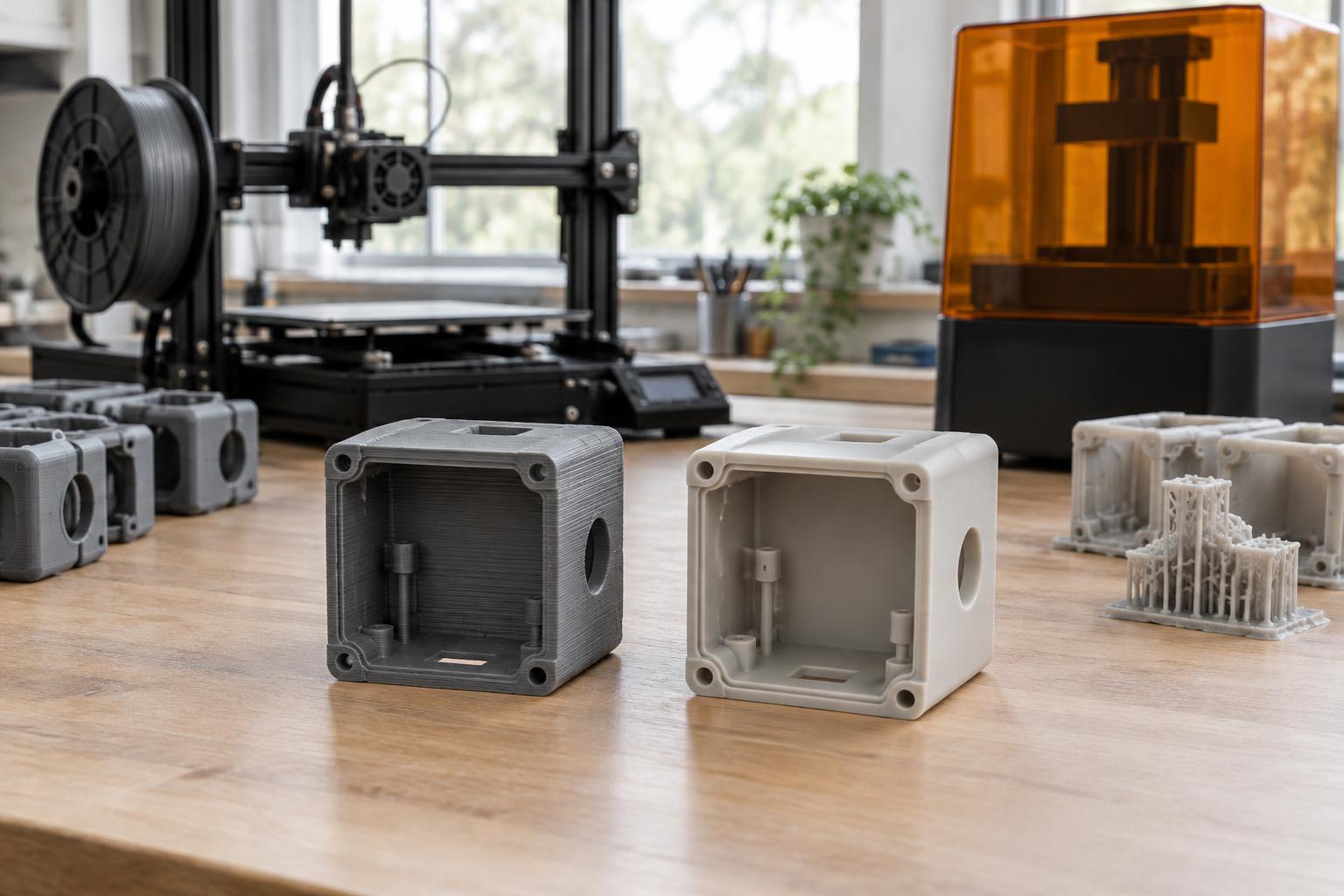
Fused deposition modeling, or FDM, melts a thermoplastic filament and deposits it in paths, building a part layer by layer. Stereolithography, or SLA, uses light to cure liquid resin in successive layers. Both start with a digital model that must be prepared for printing, but the way each process forms and supports the part leads to different results.
FDM is often a practical starting point for early prototypes. It can produce brackets, enclosures and fit-check models without a lengthy finishing workflow. SLA is often chosen when small features, smooth surfaces or a presentation-ready appearance matter more. Neither method is automatically more accurate for every shape: printer condition, material, orientation, support placement and post-processing all affect the finished part.
Choose according to what the prototype must prove
A prototype intended to check overall size, hand feel or assembly clearance may not need a fine surface finish. For that work, FDM can make iteration straightforward: change the model, print another version and compare it with the mating parts. Its visible layer lines and print paths are usually acceptable when the goal is learning about form rather than appearance.
SLA can be useful for models with fine lettering, detailed textures or tight visual requirements. It can help a team judge how a small feature or smooth curve will look, although a good-looking print is not proof that a future production material will behave the same way. For either process, define the question before printing. A visual model, an assembly trial and a load-bearing test may call for different materials, orientations or even different manufacturing methods.
Compare material behavior and part geometry
FDM parts are made from thermoplastics, but their behavior depends on both the chosen filament and the print settings. Bonds between layers can be weaker than material laid down within a layer, so orientation matters when a part will be bent, pulled or fastened. Thin walls, steep overhangs and enclosed cavities may also require design changes or removable supports.
SLA resins are available with different intended properties, yet a resin part should not be assumed to behave like an injection-molded thermoplastic. Some formulations may be more brittle or less suitable for prolonged exposure to heat or sunlight. SLA also needs supports for many shapes, and contact points can leave marks. Check the material guidance for the intended use, and test the actual printed geometry if performance matters.
Account for the work after printing
An FDM print may be ready after supports are removed and rough edges are trimmed. Sanding, filling or coating can improve its appearance, but these steps add labor and may change dimensions. Parts that must fit together should be checked at critical holes, slots and contact surfaces rather than judged only by how closely the digital models align.
SLA usually has a more involved finishing sequence. Prints commonly need cleaning, support removal and additional curing according to the resin and equipment instructions. Uncured resin and cleaning materials require appropriate handling and disposal. A smooth surface straight off the printer can still have support marks or dimensional changes from finishing. When comparing processes, count this hands-on work alongside print time and material use.
Plan small batches for consistency
A successful single print does not guarantee an identical batch. Part orientation, support layout and machine settings should be documented before repeating a job. Arrange parts so they can be removed and finished consistently, and decide which dimensions or cosmetic surfaces need inspection. A simple reference sample can make it easier to spot changes between print runs.
FDM may suit a batch of functional-looking parts with modest finish requirements, especially when each part can be printed with little support. SLA may suit small, detailed parts, but cleaning and curing every piece can become a significant part of the workload. Compare the complete workflow, not just the time shown by the printer. If the batch is likely to grow, use the first run to identify design changes that would also make a later production process easier.