Two ways to make a joint
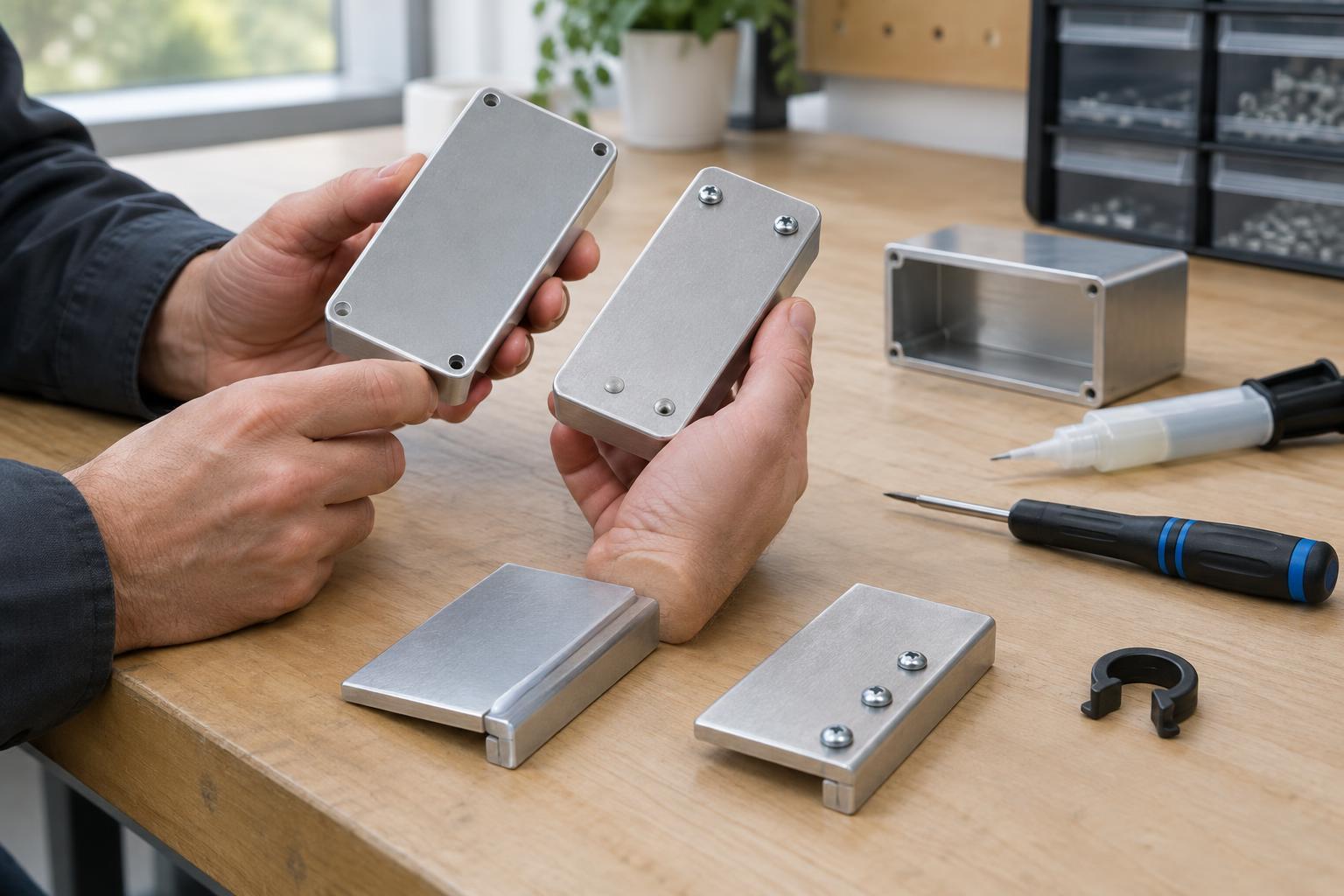
Product assembly often comes down to a simple question: how should one part stay attached to another? Adhesive bonding uses a material placed between surfaces to create a connection as it sets or cures. Mechanical fastening uses a physical feature or component, such as a screw, rivet, bolt or clip, to hold parts together. Neither method is universally stronger or easier. The better choice depends on the materials, the forces the joint will face and what must happen to the product after assembly.
A joint should be considered early in product design, not treated as a final assembly detail. It can determine the shape and thickness of parts, the tools needed on a production line and whether a customer can open the product for repair. It may also affect appearance: bonding can hide the joining method, while a fastener may remain visible or require a cover.
Where adhesives work well
An adhesive can spread a load over a broad area instead of concentrating it around a hole. That makes bonding useful for thin panels, mixed materials and assemblies where drilling or installing fasteners would be awkward. It can also join parts while sealing a seam or reducing movement between surfaces. Those benefits depend on selecting an adhesive compatible with both materials and the conditions the product will encounter.
Joint shape matters as much as adhesive choice. Bonded joints generally perform best when loads are carried across an overlap in shear, meaning the joined surfaces try to slide past each other. A force that lifts an edge can create peel, concentrating stress in a small region. Designers may use a wider overlap, a supported edge or another joint feature to reduce that risk. Surface preparation is equally important: oil, dust, coatings or inconsistent surface texture can prevent a reliable bond even when the adhesive itself is suitable.
Bonding also adds process requirements. Operators or equipment may need to control the amount and placement of adhesive, the pressure applied while parts are held together, and the time allowed before handling or loading the joint. Some products can move quickly to the next step; others need fixtures or storage space while the bond develops. A joint that looks neat from the outside may still be difficult to assess without a defined process and suitable tests.
Where fasteners earn their place
Mechanical fasteners create a connection whose installation is often straightforward to observe. A screw can be tightened to a specified condition, and its presence can be checked visually. Bolts may provide substantial clamping force; rivets can make a permanent connection without needing access for later tightening; clips can speed assembly when the parts have been designed to receive them. Each option has its own limits, so the word “fastener” does not describe a single level of strength or durability.
Fasteners usually require room for holes, bosses, threads or snap features, as well as access for an assembly tool. Holes remove material and can concentrate stress, while poorly designed plastic bosses or clips may crack during installation or repeated use. A fastener can also loosen, corrode or damage the material it grips. These risks are managed through joint design, material choice and assembly controls rather than by assuming that a visible connection is automatically a dependable one.
Production, inspection and repair
On a production line, the quickest operation is not always the quickest overall process. Dispensing an adhesive may take little time but introduce curing, handling and cleanup steps. Installing a screw takes a separate tool action, yet the assembly may be ready to move immediately. The comparison should include equipment, fixtures, operator access, process variation and what happens when a part is assembled incorrectly.
Inspection differs too. For a fastened joint, a missing fastener or damaged head may be apparent, though appearance alone cannot confirm proper installation. For a bonded joint, coverage and surface preparation may be hidden after the parts meet. Manufacturers commonly rely on controlled preparation and application, alongside checks appropriate to the joint. If repair or replacement is expected, a removable screw may be preferable to a bond that requires prying, heat or part damage to separate. Some permanent fasteners are difficult to remove as well, so serviceability must be specified rather than assumed.
Choosing the joint for the whole product
Begin with the job the joint must do. Identify the materials, available joining area, direction of expected forces, exposure to moisture or temperature changes, desired appearance and whether the product must be opened. Then consider how the joint will be made repeatedly and how defects will be found. A small prototype assembled carefully by hand may not reveal problems that arise when the same steps are repeated across many units.
The choice need not be exclusive. An adhesive may distribute load or seal a seam while fasteners hold parts in position during curing or allow selected components to be removed. Conversely, a primarily fastened assembly may use a bonding material for a particular panel or interface. The soundest decision is the one that accounts for design, assembly, use and end-of-life together—not simply which joining method seems strongest in isolation.