Paper starts with fibers and water
Most paper is made by separating plant fibers, mixing them with water and bringing them back together as a thin, continuous sheet. Wood is a common fiber source, but mills may also use recovered paper or other plant materials. The fibers provide the sheet’s structure; the process determines how evenly they are distributed and how strongly they bond.
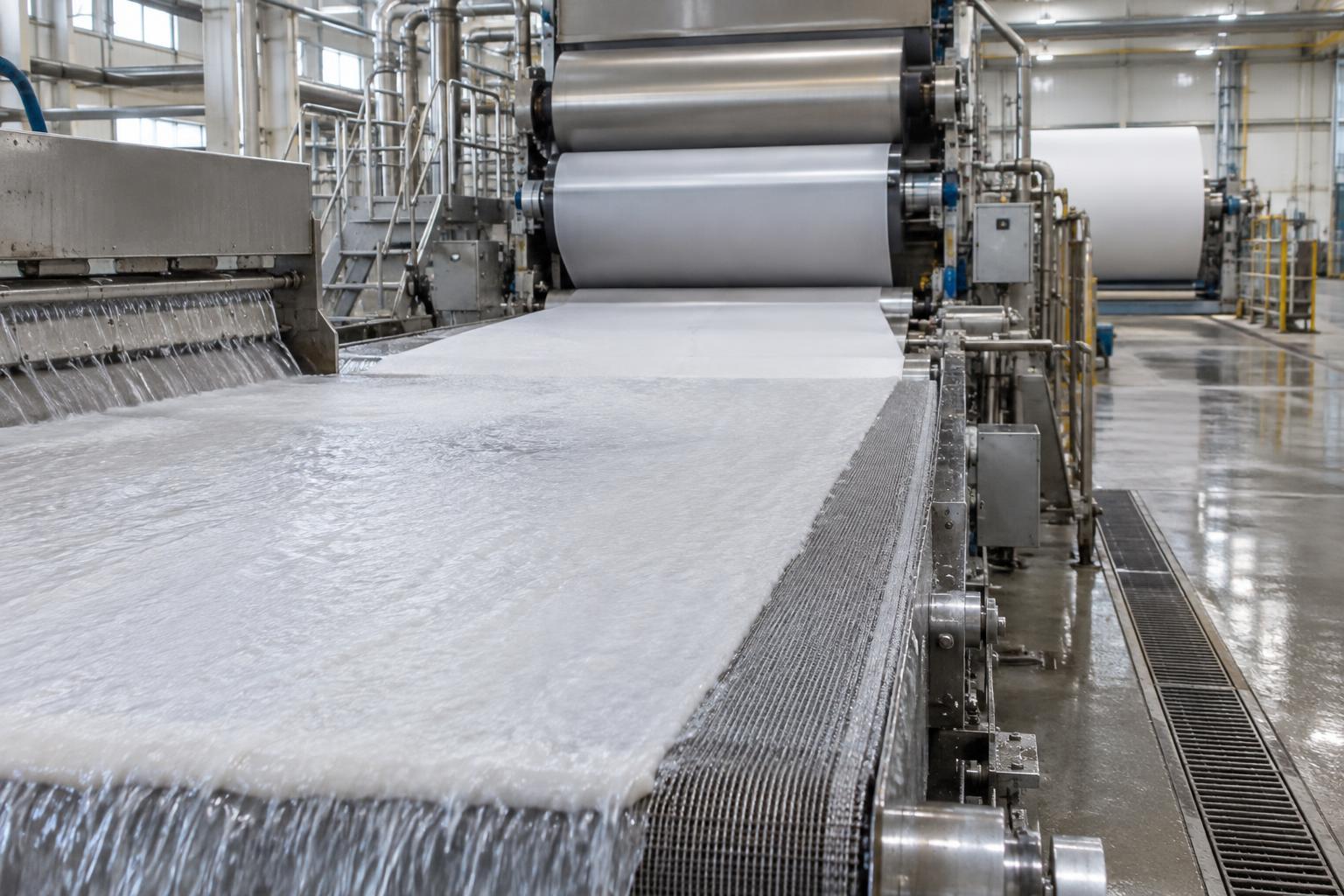
A paper machine runs continuously, so the material moves through linked stages rather than being made one sheet at a time. Although machines and recipes vary, the basic route is consistent: prepare the pulp, form a wet web, remove water, then finish and wind the dry paper. Small changes along that route can make paper better suited to printing, folding, packaging or writing.
Pulping separates and prepares the fibers
In pulping, the aim is to free usable fibers from the raw material. Mechanical pulping separates wood fibers largely through grinding or refining. It uses much of the wood, but the pulp retains more of the components that can affect color and aging. Chemical pulping uses cooking chemicals to remove much of the material binding the fibers together. It generally produces fibers that can make stronger paper, though it yields less pulp from a given amount of wood. A paper grade may use one type or a blend.
Recovered paper follows a different route. It is mixed with water until it breaks apart, then screened and cleaned to remove unwanted material such as plastic, grit or staples. If the intended paper calls for it, the mill may also remove printing ink. Recovered fibers are not identical to fresh ones: repeated use and processing can change how well they bond, so the mix is chosen for the required grade.
Before forming, the pulp may be washed, screened and refined further. Refining works the fiber surfaces so they can bond more readily, but too much can slow drainage. Makers may also add materials for properties such as opacity, color or resistance to liquid penetration. These choices are part of a recipe, not a universal requirement for every paper.
Sheet formation turns dilute pulp into a wet web
At the forming section, prepared pulp is diluted and delivered through a headbox, which spreads it across the width of a moving mesh fabric. Water drains through the fabric while fibers remain on top, creating a fragile web. The distribution of fibers matters: uneven flow can leave thick and thin patches that affect appearance, strength and printing.
Drainage must be controlled rather than simply made as fast as possible. The forming fabric supports the web, while machine settings help manage how water leaves it. Fibers can also tend to align with the direction of travel, giving paper different properties along and across the machine direction. This is one reason a sheet may fold, tear or expand differently depending on its orientation.
By the time the web leaves the forming section, it looks recognizably like paper, but it still contains a great deal of water. It needs more support and water removal before it can be handled as a finished sheet.
Pressing and drying remove the remaining water
The wet web passes through a press section, where rolls and absorbent felts squeeze out water while supporting the sheet. Pressing also brings fibers closer together, encouraging bonds that contribute to strength. The pressure must suit the grade: excessive compaction could reduce bulk in a paper intended to feel thick or cushion a package.
After pressing, the web travels through a drying section, commonly over heated cylinders. Heat evaporates water that cannot be removed efficiently by squeezing alone. Keeping drying reasonably even across the sheet helps limit problems such as curl or uneven dimensions. The paper must be dry enough for its intended use, but its final condition also depends on the moisture it holds when it is wound and stored.
Finishing makes the sheet fit for use
Some papers receive surface treatments after the main drying stage. Surface sizing, for example, can change how the sheet responds to water-based liquids, while a coating can create a more uniform printing surface. The paper may then pass through calender rolls to adjust its smoothness and thickness. Each treatment involves a trade-off: greater smoothness may be useful for printing, while more bulk may be desirable for other products.
Finally, the continuous sheet is wound into a large reel and can be cut into smaller rolls or sheets. Makers check properties relevant to its use, such as thickness, strength, appearance and moisture. Tracing a finished sheet back through these stages makes many differences between papers easier to understand: the fiber recipe sets the possibilities, and forming, water removal and finishing turn that recipe into a usable product.