From ingredients to molten glass
Bottle production begins with a batch of raw materials. Silica sand supplies much of the glass-forming material, while other ingredients help the mixture melt and give the finished glass suitable properties. Manufacturers often add cullet—crushed glass prepared for remelting. The recipe depends on the bottle’s intended use and color, and contamination in any ingredient can cause problems later in production.
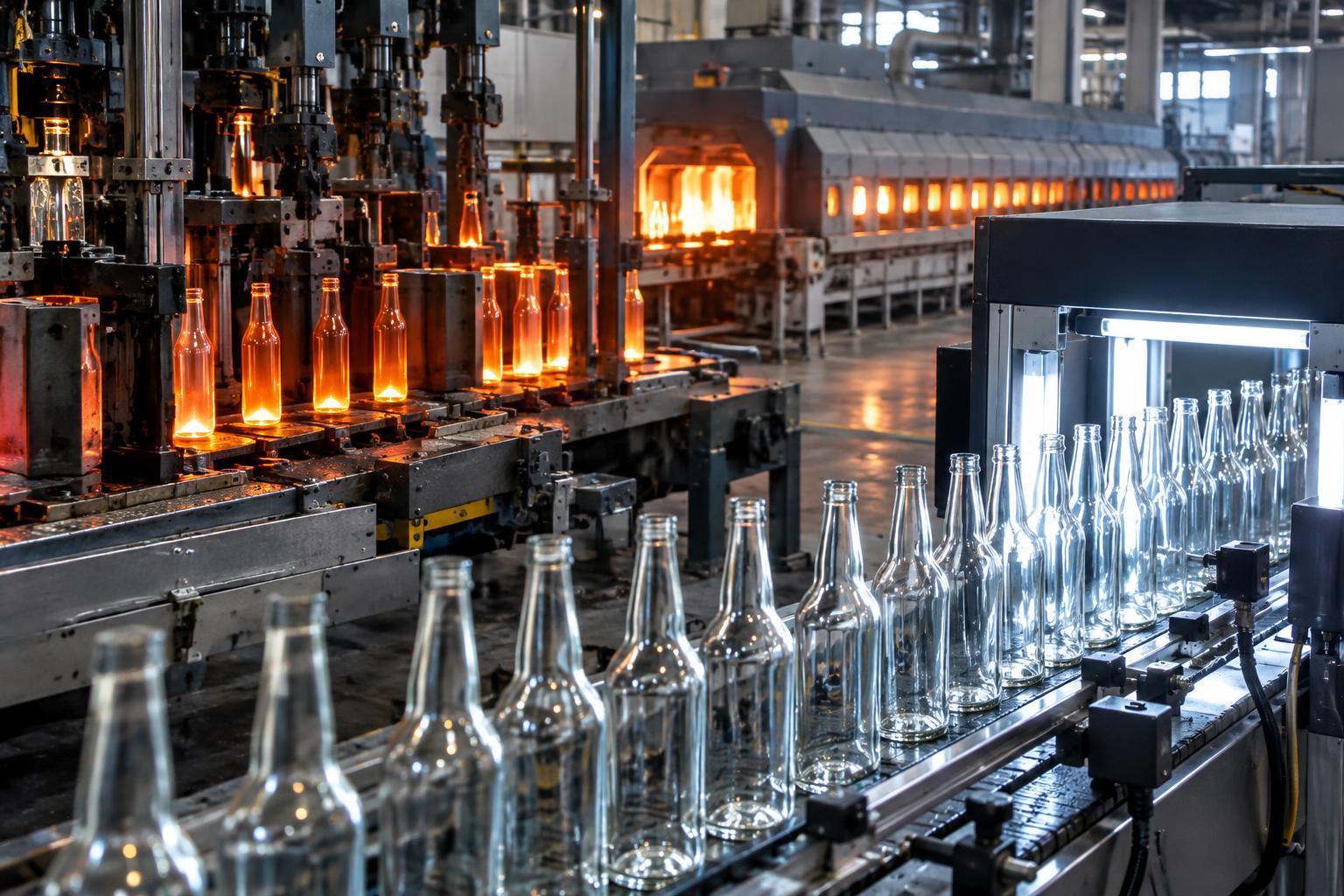
The batch enters a furnace, where heat turns it into molten glass. The glass must be worked at a suitable temperature: if it is too stiff, it may not fill the mold properly; if it is too fluid, controlling its shape becomes harder. Before forming, the melt is divided into measured portions called gobs. Consistent gob size helps keep bottle weight and wall thickness within the intended range.
Giving the bottle its shape
A gob enters the first mold and becomes a preliminary shape called a parison. Forming equipment then transfers the parison to a final mold, where it expands into the bottle’s finished shape. Two common approaches are blow-and-blow, which uses air during both forming stages, and press-and-blow, which uses a plunger in the first stage before air shapes the bottle in the final mold. The chosen method depends on the container design and production requirements.
The mold defines details that matter beyond appearance. The neck finish must fit the intended closure, the base must let the bottle stand securely, and the body must have enough material in the places where it is needed. Mold condition, gob placement, forming temperature and timing all affect the result. A bottle can look symmetrical from a distance yet have uneven walls or a misshapen sealing surface.
Why bottles need gradual cooling
A newly formed bottle is hot on the outside and may cool at a different rate through its walls and base. If it cools too quickly or unevenly, internal stresses can remain in the glass. Those stresses can make a bottle more likely to crack during handling or use, even if it appears sound when it leaves the mold.
To reduce this risk, bottles pass through an annealing lehr, a temperature-controlled tunnel. They are held warm and then cooled gradually so temperature differences within the glass can diminish. Annealing is not a way to repair a badly formed bottle; it addresses stresses created during cooling. Temperature settings and travel time must suit the container, since a thick base and a thin shoulder do not lose heat in exactly the same way.
What inspection looks for
After cooling, bottles are checked against the features needed for filling, closing and handling. Inspections may look for cracks and checks—fine fractures in the glass—as well as chips, trapped bubbles, unwanted particles or areas where the glass has not formed correctly. The opening and sealing surface receive particular attention because faults there can interfere with a cap or other closure.
Production lines may combine cameras, sensors and mechanical gauges to examine bottles as they pass. Checks can include dimensions, wall or base characteristics, and whether a bottle can stand and travel reliably on a conveyor. Inspection methods vary with the bottle and the equipment available. A rejected bottle may be recycled as cullet where the process allows, but inspection cannot replace control of the melt and forming stages: preventing recurring defects is more effective than finding them at the end.
From accepted bottle to usable package
Bottles that pass inspection are arranged for storage or transport, often with handling methods designed to limit impacts and surface damage. The maker also needs to keep different designs and production batches identifiable so a problem can be traced to the relevant run. For bottles intended for food or drink, cleanliness matters as well as shape and strength; the filling operation has its own procedures for preparing containers before use.
The overall process is a sequence of linked controls rather than a single molding step. A well-measured gob supports even forming, a sound mold supports the correct shape, annealing limits residual stress, and inspection catches bottles that do not meet requirements. Understanding those links explains why two bottles with nearly identical silhouettes may not perform the same way on a filling line or in everyday handling.