Start with the job the joint must do
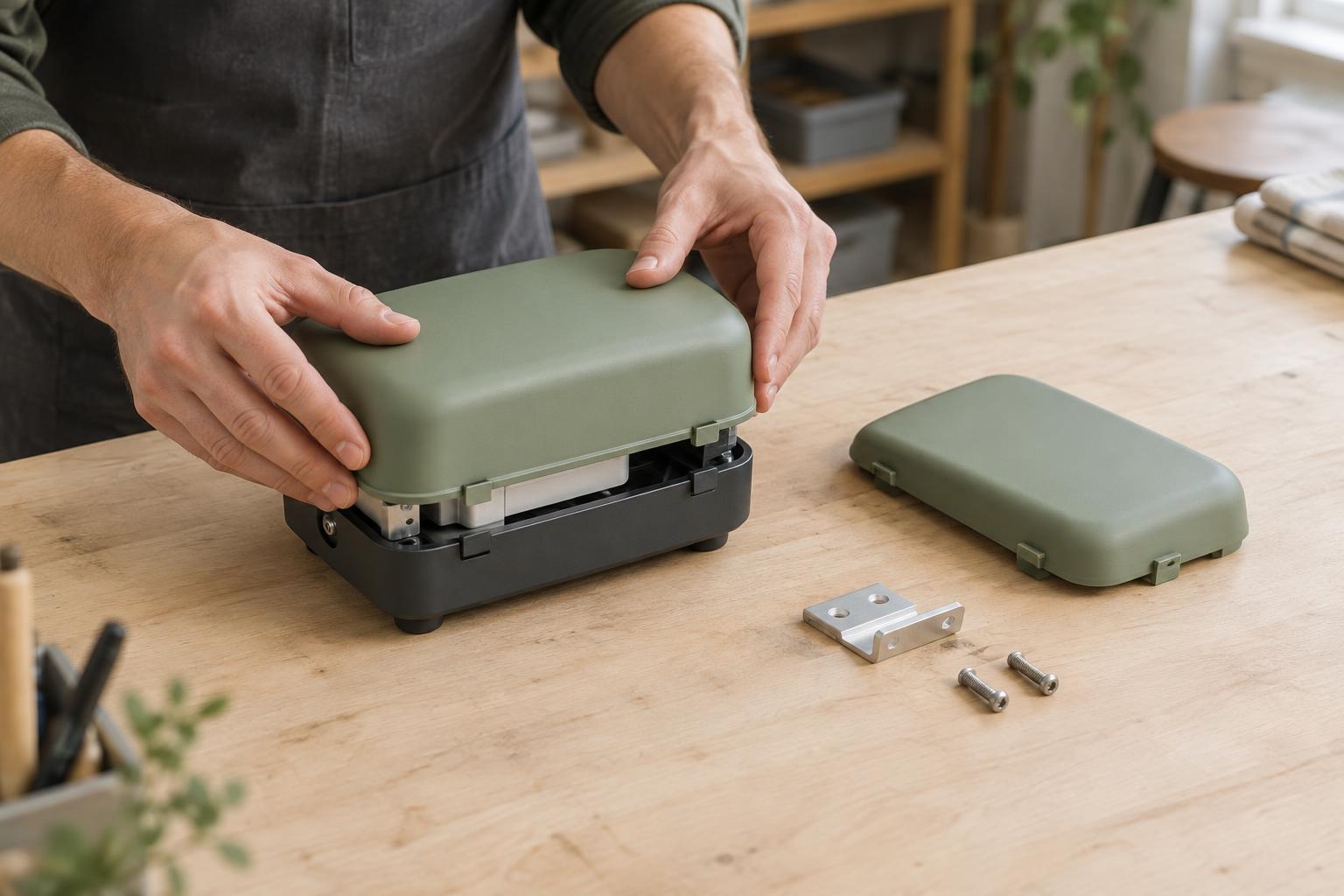
A snap-fit joint connects parts when a flexible feature bends during assembly and returns toward its original shape after passing a mating feature. A familiar example is a plastic tab with a small hook that clicks behind an edge. The appeal is straightforward: a snap-fit can reduce separate fasteners and make assembly possible with a simple push. But a satisfying click does not, by itself, show that the joint will hold securely or survive repeated use.
Before drawing the hook, decide whether the connection is meant to be permanent, occasionally opened for repair, or opened routinely. Identify the directions in which the finished product will be pulled, twisted or dropped, and consider who will assemble and release it. These decisions shape the design: a joint that should resist accidental opening may need a different release path from a lid that a user must remove by hand.
Give the flexible member room to work
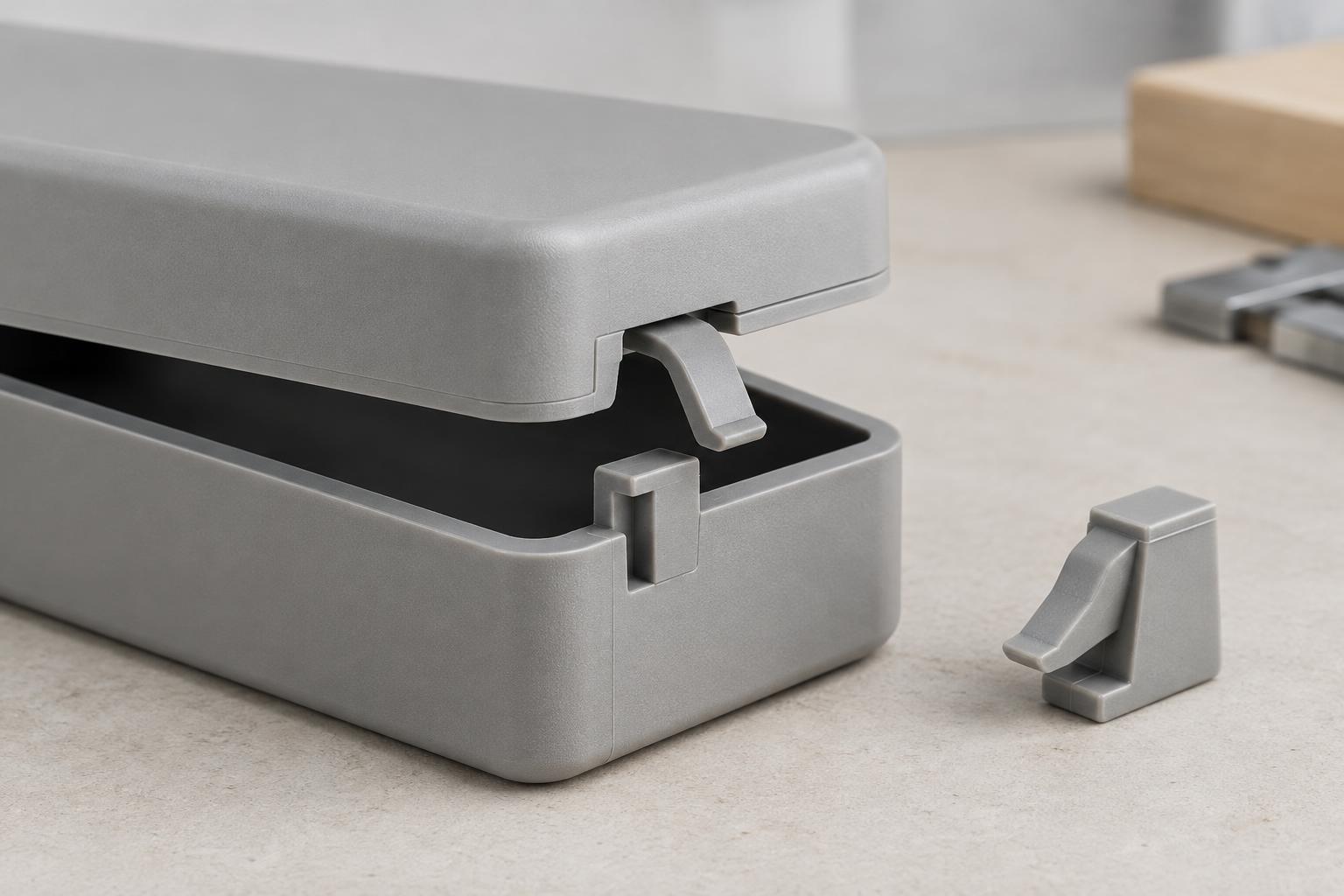
Many snap-fits use a cantilever: a narrow arm fixed at one end, with a catch near the free end. During insertion, a sloped surface guides the arm aside. Once the catch clears the mating edge, the arm moves back and the catch engages. A longer, more gradual flexible region can often achieve the needed movement with less concentrated bending than a short, stiff tab. The surrounding housing must also provide clearance for that movement; an arm cannot flex as intended if it immediately contacts a nearby wall.
Pay particular attention to the arm’s fixed end, where bending tends to concentrate. A smooth transition into the main part is generally preferable to an abrupt corner. Sharp notches, sudden thickness changes and molding defects can make failure more likely there. The required deflection should be only enough to clear the mating feature, allowing for expected dimensional variation. Asking the arm to travel farther than necessary raises assembly effort and may leave it permanently bent.
Separate insertion effort from holding strength
The surfaces that guide a snap-fit together need not have the same shape as the surfaces that hold it closed. A gradual entry ramp can make assembly easier, while the retaining face can be shaped to resist a pull in the expected direction. The depth of engagement matters too: too little overlap may allow the catch to slip free, while excessive overlap may demand more bending during assembly or release. The mating edge must be strong enough to carry the load without bending away from the catch.
Retention is a property of the whole connection, not just the hook. If a cover can pivot or bow, that movement may peel a catch away even when a straight pull does not. Multiple snaps can distribute loads, but they can also make assembly difficult if one side locks before the other is aligned. Locating surfaces, ribs and stops can help position the parts and carry loads that would otherwise fall on the flexible tabs.
Design release deliberately
For a serviceable joint, provide a clear way to move the catch out of engagement without forcing the surrounding parts apart. That might be a finger-accessible tab, a defined press area or an opening for a suitable tool. Consider where the user will grip the product and whether pressing the release could accidentally increase the load on another snap. If opening requires a particular sequence, the geometry should make that sequence understandable rather than relying on guesswork.
A release feature also needs protection during normal use. A tab exposed where hands routinely press may be opened unintentionally; one buried too deeply may be damaged by improvised tools. The aim is to make intentional release predictable while keeping incidental contact from disengaging the joint. For a connection not intended to reopen, avoid presenting a misleading release point, and consider how the product could be disassembled at the end of its life.
Check material, production and real-world variation
Material choice changes how a snap-fit behaves. Plastics differ in stiffness, toughness and response to repeated bending, temperature and long-term load. A material that works for a one-time assembly may not suit a frequently opened enclosure. Manufacturing also affects the result: molded part thickness, tool access, draft and the direction in which a feature must leave the mold can constrain the geometry. A design should be reviewed as a manufacturable pair of parts, not as an isolated tab.
Prototypes are most useful when tested as complete assemblies across plausible dimensional variation. Check how much effort assembly takes, whether each catch engages fully, how the joint behaves under the expected loads and whether release damages any feature. Repeat opening and closing if reuse is part of the brief, and inspect for whitening, cracks or a tab that no longer returns. Refine the geometry around those observations: the best snap-fit is not simply the tightest one, but one that assembles, holds and releases as intended.