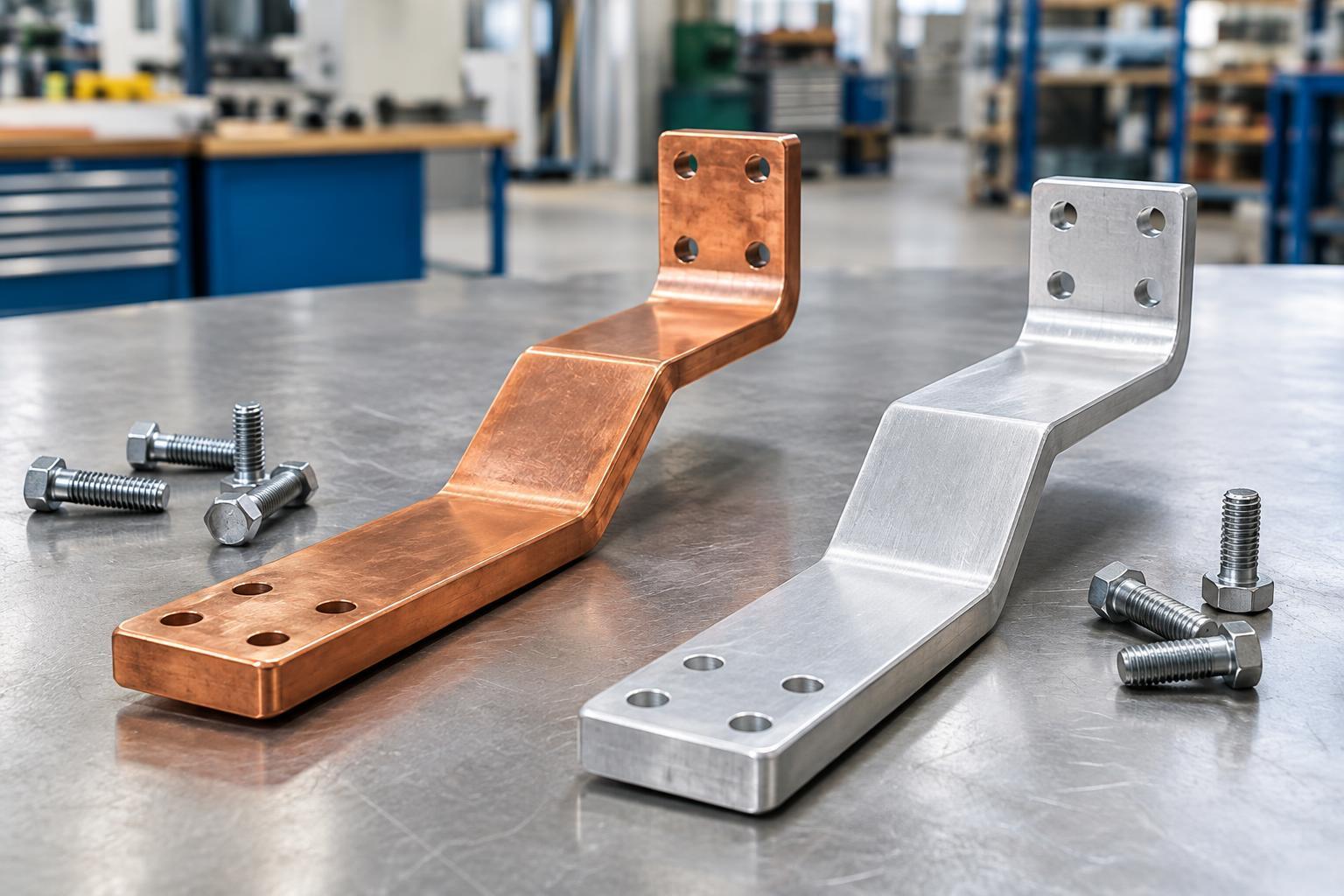
Start with the shape of the part
Copper and aluminum are both used to carry electricity, but neither is the better choice in every product. Copper offers higher electrical conductivity for a given cross-sectional area. Aluminum is much lighter for the same volume. The practical question is often not simply which metal conducts better, but how much space and weight the finished part can occupy.
If two conductors have the same length and cross-sectional area, a copper one will generally have lower electrical resistance. To reach a similar resistance with aluminum, a designer typically needs a larger cross-section. That extra size may be easy to accommodate in an overhead conductor or a roomy enclosure. It can be much harder to fit into a compact connector or a densely packed assembly.
A larger aluminum part can still weigh less than the copper part it replaces. This distinction between performance per unit of volume and performance per unit of mass explains why both materials remain useful.
Conductivity is only part of the heat problem
Electrical resistance matters because current passing through a conductor generates heat. A part that runs too hot can affect nearby insulation, joints and components. Its operating temperature depends not only on the metal but also on current, dimensions, airflow, surrounding materials and the quality of its connections.
Copper also conducts heat well, which can help spread heat away from a local hot spot. Aluminum conducts heat well too, though generally less effectively than copper in an equal-size part. Neither property eliminates the need to examine the complete assembly. A broad metal bar with good airflow behaves differently from a thin conductor enclosed in plastic, even if both are made from the same material.
Electrical design therefore compares parts at their intended dimensions and conditions, rather than treating a conductivity figure as a complete answer.
Connections can decide the material choice
Many electrical problems begin at a joint rather than along the main length of a conductor. A connection must maintain reliable contact despite assembly variation, temperature changes and, in some products, vibration. Copper is often convenient where small terminals and established joining methods are priorities. Aluminum requires particular attention because its surface forms an oxide layer that can interfere with electrical contact if the joint is not designed and prepared appropriately.
Aluminum and copper also expand by different amounts as temperature changes. In a joint, that movement can affect contact pressure over repeated heating and cooling. Aluminum may additionally deform under sustained pressure, making the design of clamped connections important. These issues do not rule out aluminum; they mean that terminals, fasteners and preparation methods need to be compatible with the chosen conductor.
Where the two metals meet, moisture can contribute to galvanic corrosion. The risk depends on the environment and joint design. Suitable connectors, barriers or protective finishes may be used to keep the connection dependable, but a finish alone should not be assumed to solve every joining problem.
Manufacturing changes the comparison
Copper and aluminum can both be formed into wire, sheet and other useful shapes, yet their manufacturing routes are not interchangeable. The chosen alloy and temper influence bending, forming and strength. A thin contact, a stamped terminal and a large busbar each place different demands on the metal and on the process used to make it.
Aluminum's low weight can ease handling and reduce the mass of large assemblies. Its need for a larger cross-section at comparable resistance may, however, require different tooling, bend space or enclosure dimensions. Copper may fit more readily into a tight electrical layout, but its greater mass can matter in moving equipment or long conductor runs.
Material price alone is an incomplete cost comparison. The finished cost also includes the amount of metal required, processing, connectors, coatings, assembly time and the space needed around the part. A substitution that looks attractive at the raw-material stage may offer little benefit if it forces an expensive redesign.
Make the trade-off at assembly level
A useful comparison begins with the part's job: how much current it must carry, how long it is, what space is available and what temperatures and surroundings it will encounter. Next come weight limits, joining methods and the materials it will touch. These questions narrow the choice more effectively than a single ranking of metals.
Copper often suits compact parts where a small cross-section and straightforward integration are valuable. Aluminum can be attractive where lower weight matters and there is room for a larger conductor and appropriately designed connections. In either case, evaluating the complete path—including joints and operating conditions—gives a clearer picture than comparing two bare metal samples.