What the grade numbers tell you
304 and 316 are common austenitic stainless steels used for products ranging from kitchen equipment to industrial fittings. Both contain chromium, which helps form a thin protective oxide layer on the surface. If that layer is damaged in an environment where oxygen is available, it can generally reform. That behavior makes stainless steel resistant to many kinds of corrosion, but it does not make it rustproof.
The key difference is that 316 contains molybdenum, while standard 304 does not. Molybdenum improves resistance to localized attack, particularly in the presence of chlorides. The exact composition depends on the applicable specification, so the grade name is a starting point rather than a complete description of a purchased material. In appearance and many routine fabrication tasks, the two grades can be similar; their distinction becomes more important when the service environment is demanding.
Where 304 is often enough
For dry indoor products, ordinary household use and many applications where surfaces are regularly washed and dried, 304 is often a practical choice. It offers good formability and weldability, is widely available, and can provide a long service life when the design and maintenance suit the environment. Choosing 316 for every stainless part would add cost without necessarily improving the product in a meaningful way.
The label “indoor,” however, does not settle the question. A part beside a sink may stay damp; a food-processing component may encounter salty ingredients or cleaning solutions; a fastener may sit in a recess that is hard to rinse. Consider what actually touches the metal, how long it remains there and whether the surface can dry. Even 304 can develop staining or localized corrosion when chlorides and moisture are allowed to linger.
When 316 earns consideration
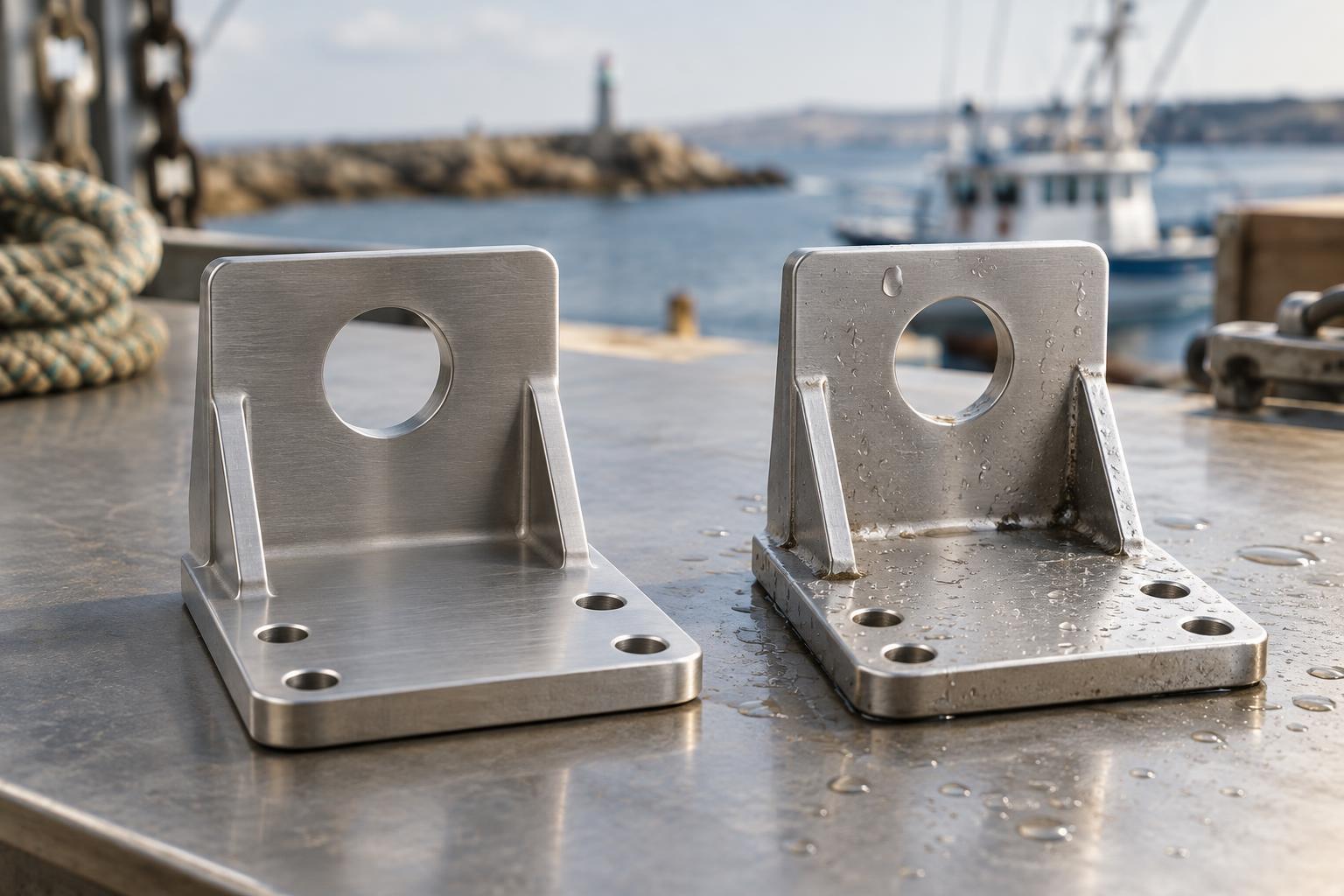
316 becomes more attractive when chloride exposure is frequent or difficult to avoid. Examples include hardware exposed to coastal spray, equipment washed repeatedly with chloride-containing solutions, and components that regularly contact salty water. Its improved resistance is especially relevant to pitting: small, concentrated areas of attack that may be less obvious than broad surface rust.
That improvement has limits. Seawater, warm chloride solutions, deposits and stagnant liquid can still cause trouble for 316. A tight gap under a gasket, washer or overlapping sheet can hold moisture and develop conditions different from those on the open surface. In such a crevice, corrosion may occur even when the surrounding metal looks sound. For severe or safety-critical service, neither 304 nor 316 should be assumed suitable solely because it is called stainless steel; the full exposure conditions and product requirements need to be assessed.
Design and processing matter alongside alloy choice
Material selection is only one part of corrosion resistance. A smooth, clean surface is generally easier to rinse and inspect than a rough one. Details that drain freely help reduce the time that salty or dirty water remains in contact with the metal. Avoiding unnecessary overlaps and inaccessible corners can be as valuable as changing grades. Contact with other metals, deposits from tools and contamination introduced during fabrication can also affect the finished part.
Welding deserves particular attention. Low-carbon versions, designated 304L and 316L, are often specified for welded components because they reduce the risk of certain corrosion problems associated with heat-affected areas. They do not solve poor drainage or make a weld immune to attack. Suitable fabrication practices, cleaning and, where appropriate, passivation help preserve the surface condition expected from the chosen grade. Those steps should be planned as part of production, not treated as a repair after corrosion appears.
A practical way to make the choice
Start by listing the product’s expected exposures: water, salt, cleaning agents, temperature, contact time and periods when the part cannot dry. Then identify features that trap liquid and decide how the user will clean or inspect them. If exposure is mild and the design supports drying, 304 may meet the need. If chlorides are a recurring part of normal use, 316 may offer a useful margin—provided the design and cleaning approach are also appropriate.
Finally, specify what will actually be supplied. A drawing or purchase order should identify the grade and any relevant low-carbon designation, finish and fabrication requirements. For important parts, material documentation and suitable verification can help prevent a mix-up; appearance or a simple magnet check alone cannot reliably distinguish 304 from 316. The best choice is not the grade with the higher number. It is the material-and-design combination that fits the real conditions of use.