What sunlight does to plastic
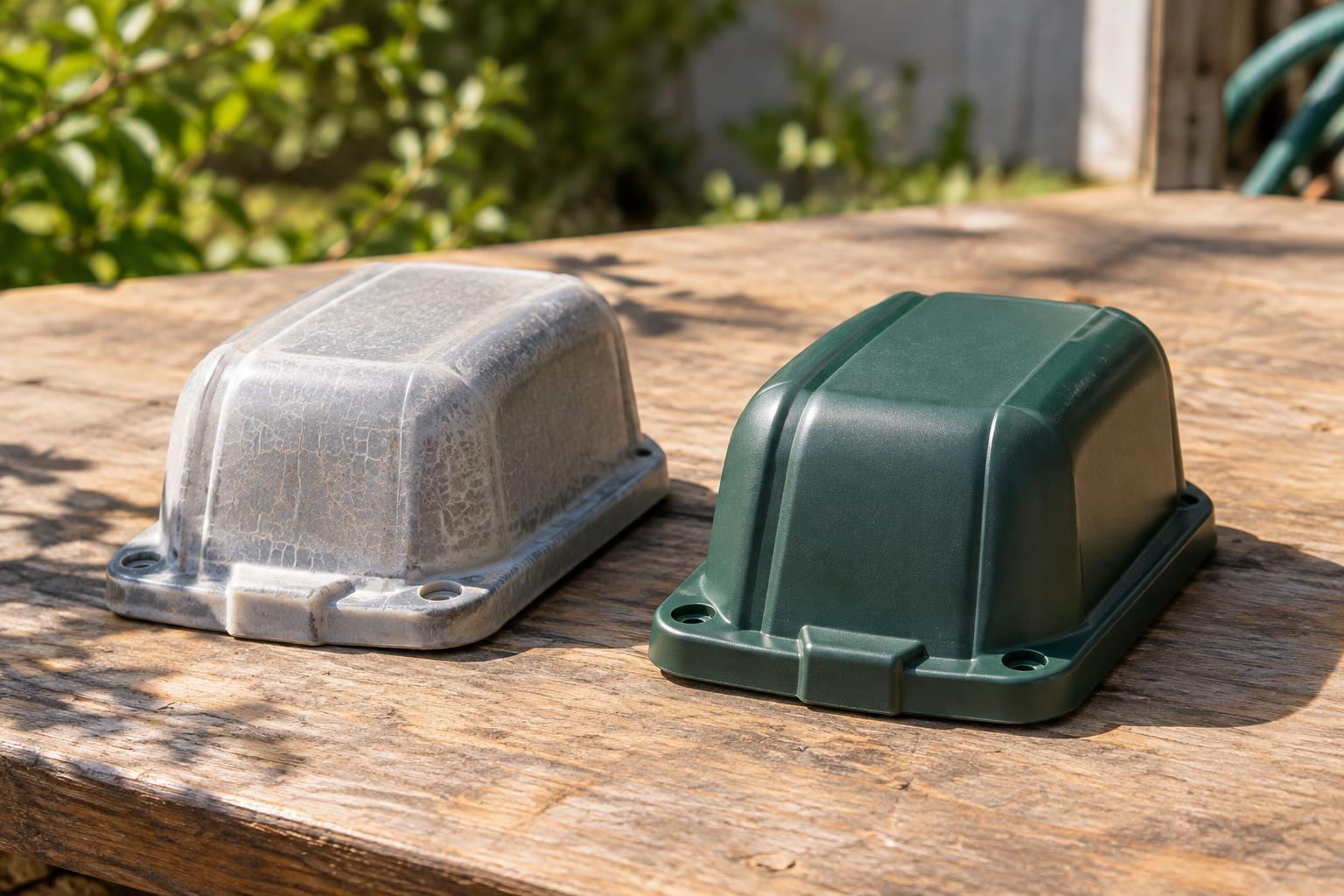
A plastic garden fitting, sign, or equipment housing may look sound when it leaves the factory but become faded or brittle after time outdoors. Ultraviolet (UV) light is one reason. Its energy can trigger chemical changes in some polymers, particularly at exposed surfaces. Oxygen often participates in these reactions, so the process is commonly called photo-oxidation. Heat and moisture can contribute to weathering as well.
The visible signs vary. A surface may lose gloss, change color, develop a powdery layer, or form small cracks. More importantly, the part may lose the flexibility or strength it needs to do its job. Appearance and performance do not always change at the same rate: a faded cover might still function, while a seemingly acceptable clip could have become easier to snap.
Start with the job the part must do
There is no single best outdoor plastic. Selection depends on what the part must withstand and which changes are acceptable. A decorative panel may need to retain its color; a latch must keep working after repeated bending; a clear cover may need to stay transparent. Begin by defining the required appearance, strength, flexibility, and expected service life. Then consider where the product will be used, including exposure to direct sun, shade, heat, rain, and cleaning products.
Material names alone are not enough to make a choice. Different grades of the same polymer can behave differently because their formulations differ. A supplier’s outdoor or UV-stabilized grade may be a better starting point than a general-purpose grade, but its suitability still depends on the finished part and its conditions of use.
Compare material families and formulations
Common plastics offer different combinations of properties. Polypropylene and polyethylene are useful for many molded products, but outdoor versions generally need appropriate UV protection. Standard ABS can be vulnerable to weathering, while ASA is often considered when an ABS-like rigid part needs better resistance to outdoor exposure. Acrylic is valued for clear parts where weathering and light transmission matter. Polycarbonate can offer high impact resistance, but an outdoor application may call for a UV-protected grade or coating.
Formulation can be as important as polymer choice. UV absorbers, stabilizers, pigments, and protective coatings may help slow damage. Carbon black can provide effective UV screening in a well-formulated part, though it is unsuitable when a light or transparent appearance is required. Colorants also need consideration: even if the base plastic retains its strength, a poorly matched pigment may fade. Ask suppliers about the complete grade and color formulation rather than assuming an additive can be specified independently.
Design the part to reduce avoidable failures
Good material selection cannot compensate for every design weakness. Thin sections and sharp corners may concentrate stress, making damage more consequential as a material ages. Clips, hinges, and fasteners deserve particular attention because they combine outdoor exposure with repeated loading. Where practical, give these features suitable thickness and generous transitions, and avoid placing a highly stressed feature where it receives the most sun.
Think about the whole assembly, too. A roof or overhang may shade a vulnerable component, while a dark surface may become hotter in direct sunlight than a lighter one. Clear parts may need protection without losing too much light transmission. Coatings or replaceable covers can be useful, but they add their own requirements for adhesion, maintenance, and assembly. The best solution may combine a suitable resin grade with thoughtful geometry and placement.
Verify the finished product, not just the material
Supplier information helps narrow the options, but testing should reflect the actual part. Accelerated weathering tests expose samples to controlled light and, in some methods, moisture. They can help compare candidate formulations and reveal changes in color, surface condition, or mechanical performance. They are not a simple clock that predicts an exact number of years outdoors: real exposure varies with location, orientation, season, and use.
Set pass criteria before comparing samples. Measure what matters for the product, such as color change for a visible panel, impact strength for a housing, or retention force for a clip. Include the intended color and manufacturing process in evaluation, since a finished molded part may differ from a supplier’s test specimen. Outdoor exposure trials, when practical, can complement accelerated tests. Choosing an outdoor plastic is ultimately a process of matching a specific formulation and design to a clearly defined job, then checking that the combination performs as intended.