What is being compared?
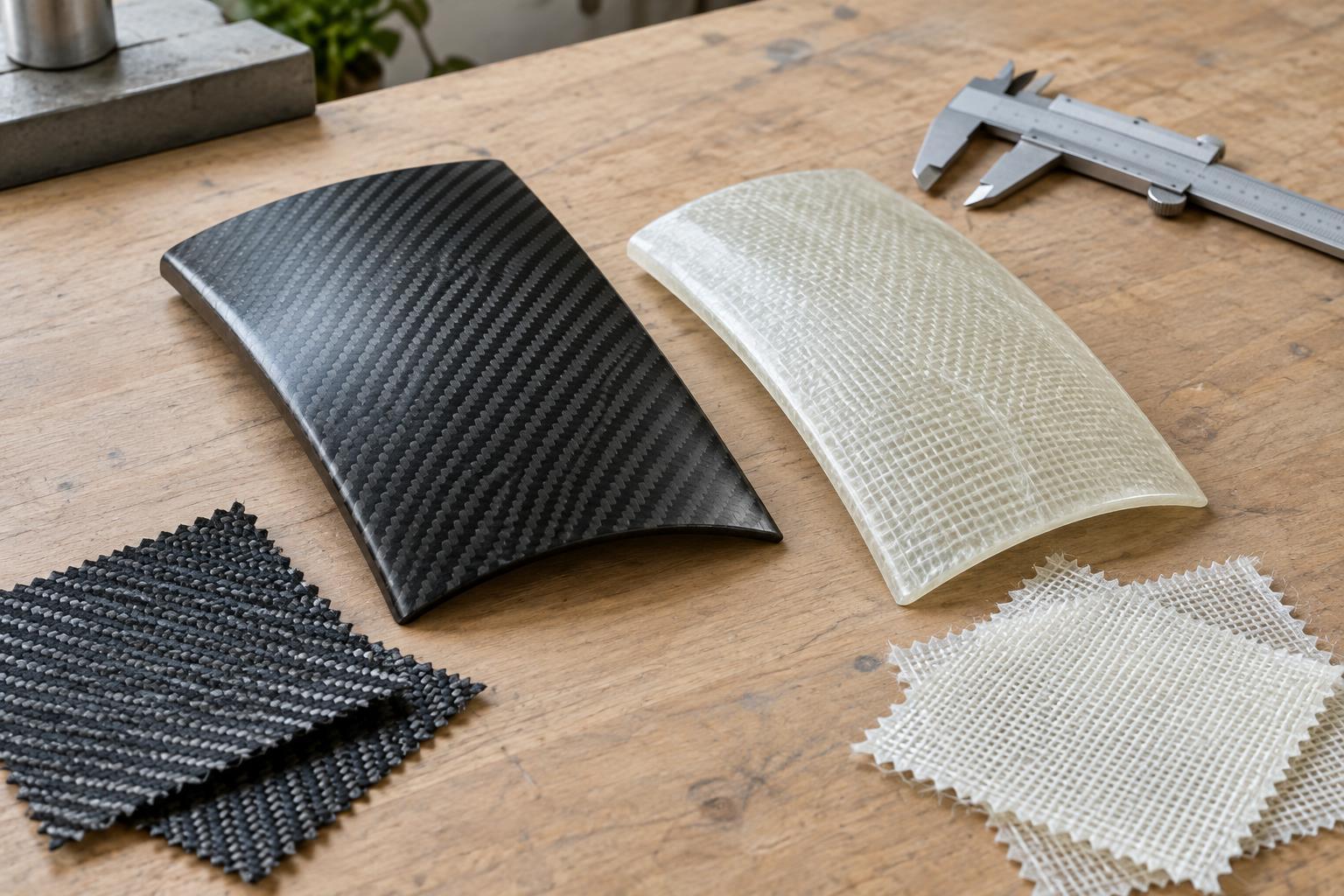
A fiber-reinforced composite combines reinforcing fibers with a surrounding material called a matrix, usually a polymer resin. The fibers carry much of the load; the matrix holds them in position, transfers force between them and helps protect them from the environment. Carbon and glass fibers can each be supplied in forms such as woven fabric, unidirectional tape or chopped strands. Those forms do not behave identically, even when made from the same fiber.
That is why “carbon versus glass” is only a starting point. Fiber direction, fiber content, resin choice, part thickness and manufacturing quality all affect the finished component. A fair comparison begins with a specific job: what loads the part must carry, how much it may bend, what it will be exposed to and how it will be made.
Stiffness, strength and weight
Carbon fiber’s clearest advantage is stiffness for its weight. Where a panel or beam must resist bending without becoming heavy, a well-designed carbon composite can be attractive. Glass fiber is generally less stiff, so a glass-fiber part may need to be thicker or shaped differently to meet the same deflection limit. That extra material can reduce the weight advantage suggested by comparing fiber densities alone.
Strength is less straightforward. Both materials can make strong parts, but the outcome depends on fiber orientation, resin, defects and the type of loading. Impact behavior also deserves separate attention: a part that is stiff in ordinary use may still suffer damage from a sharp blow. Neither fiber guarantees a tougher finished product. Designers often examine how damage begins, whether it remains visible and whether the part can continue to serve safely after it occurs.
Environment and electrical behavior
Glass fiber is electrically insulating, which can be useful for housings, covers and components near electrical equipment. Carbon fiber conducts electricity, so a carbon composite may require extra care around wiring or conductive surfaces. When carbon composites contact certain metals in the presence of moisture, galvanic corrosion can also become a design concern. Coatings, insulating layers or different fastening details may help manage that interface.
Environmental resistance is not determined by the fiber alone. The resin and surface protection influence how a part responds to moisture, sunlight, chemicals and temperature. Long-term exposure can affect properties or appearance, so the intended environment should be part of material selection. A specification that names only the fiber leaves important questions unanswered.
Why the finished-part cost can differ from the material price
Glass fiber is typically the less expensive reinforcement, making it appealing when cost is a strong constraint and its performance meets the brief. Carbon fiber usually carries a higher material cost. Yet the bill for a finished part also includes resin, tooling, labor, scrap, inspection, finishing and assembly. A cheaper fiber does not automatically produce the cheaper part if meeting the requirement calls for added thickness, more components or a complicated shape.
The manufacturing route matters as well. Chopped-fiber molding can suit some complex or higher-volume parts, while carefully placed continuous fibers may deliver better directional performance at the expense of more involved processing. Both glass and carbon can be used in more than one process. For either material, wrinkles, poor wet-out or trapped voids can undermine expected properties; making a repeatable part is as important as selecting a promising fiber.
A practical way to choose
Start with the limiting requirement. If a cover primarily needs a durable shape at a controlled price, glass fiber may be sufficient. If a moving component must remain light while resisting deflection, carbon fiber may justify its premium. Where loads run mainly in one direction, placing fibers along that path may matter more than switching materials. Hybrid constructions are another option, though they add design and process complexity.
Compare candidate designs as complete parts rather than equal-sized coupons of material. Consider weight, acceptable deflection, expected damage, joining methods, appearance, production volume and repair or replacement needs. Then test representative parts made by the intended process. The useful question is not which fiber is universally better, but which design meets the requirements with an acceptable margin and a manageable total cost.