What the labels actually tell you
Virgin paperboard is made from fibers that have not previously been made into paper. Recycled paperboard uses fibers recovered from paper products or production waste. These labels describe where the fiber came from, not the complete specification of a sheet. A board can combine virgin and recycled layers, and two boards with the same recycled content can perform differently because of their furnish, thickness, coatings and manufacturing controls.
The first step in choosing between them is to define the package’s job. A folding carton for a light, dry product faces different demands from a rigid box or a sleeve around a heavy item. Required stiffness, fold quality, surface finish and contact with the packed product all matter. Looking only at the words “virgin” and “recycled” can obscure the grade and construction that will determine performance.
Strength depends on more than fiber origin
Papermaking and recycling change fibers. With repeated processing, fibers generally become shorter or less able to bond, which can affect strength. That does not mean every virgin board is stronger than every recycled board. A well-specified recycled grade may be entirely suitable for a carton, while an unsuitable virgin grade may crack at a fold or lack the stiffness a design needs.
Different forms of strength should be considered separately. Stiffness helps a package hold its shape; tear resistance matters at openings and handles; compression performance matters when packs are stacked. Thickness alone does not predict all of these properties. Grain direction also influences how a sheet bends and folds, so a carton layout that works in one orientation may perform less well when rotated.
Ask suppliers for properties relevant to the finished pack, then test samples after printing, creasing and folding. A board that looks promising as a flat sheet can behave differently on a production line or in a filled carton. If handling or storage conditions may expose the package to humidity, include that condition in the evaluation.
Appearance is a design decision, not a defect
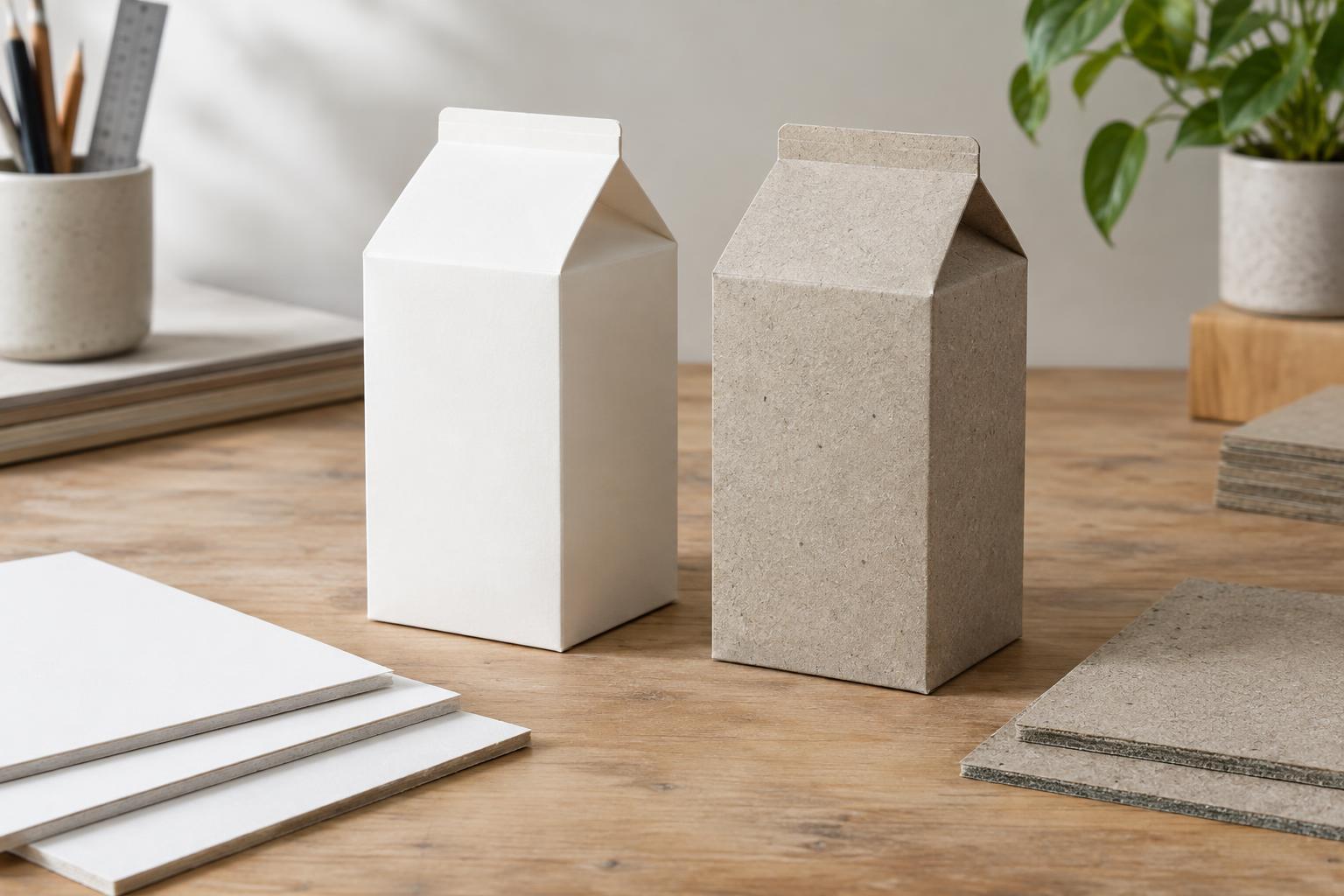
Virgin-fiber boards are often chosen when a clean, consistent white surface is important. Recycled boards may have a gray or brown reverse side and greater variation in their natural color, depending on the grade. Neither look is automatically better: a visible recycled-fiber tone can suit a restrained design, while a bright, even surface may help a color-critical print job.
Surface treatment complicates a simple visual comparison. Coatings can improve smoothness, brightness and print results on either type of board, while liners can give a multi-layer sheet a different appearance on each side. These additions may also affect cost, converting behavior and how the finished package enters a recycling stream. Rather than judging material from a small swatch, review printed proofs and folded samples under the lighting in which the pack is likely to be seen.
If the brand relies on a particular color or fine detail, agree on an acceptable range of variation before ordering. Ink coverage, board absorbency and finish can all change the final appearance, even when the artwork stays the same.
Sourcing claims need precise questions
Recycled content can reduce demand for new fiber, but it does not by itself describe every environmental impact of a package. Virgin fiber can come from managed sources, while recycled fiber must be collected, sorted and processed. Transport, mill operations, coatings and the package’s end-of-life options also influence the overall picture. Broad claims that one board is always the more sustainable choice are therefore hard to support without a defined product and supply route.
For a useful supplier conversation, ask whether recycled content is pre-consumer or post-consumer, what percentage is specified, and whether the answer applies to the whole board or only particular layers. For virgin fiber, ask how its source is documented. If a certification or other claim matters to the project, clarify exactly which material and production steps it covers.
Availability is another trade-off. A preferred grade must be obtainable in the required sheet size, quantity and lead time, with enough consistency for repeat orders. A substitute grade may require fresh print approvals or changes to creases and cutting tools.
Choose the grade around the finished package
Begin with a short list of non-negotiable requirements: what the board must hold, how it will be converted, which surfaces will be visible and whether it will touch the product. Contact-sensitive uses require particular care; do not assume that a board is suitable for food or other regulated applications based only on its fiber label. Ask for documentation appropriate to the intended use.
Then compare candidate grades as finished prototypes, not just as material descriptions. Check folding, closure, print appearance and protection during ordinary handling. Record the board grade and key properties that passed the trial so later purchases can be evaluated against the same requirements. This approach leaves room for both virgin and recycled options—and makes the decision about a working package rather than a label.