Start with the load, not the material
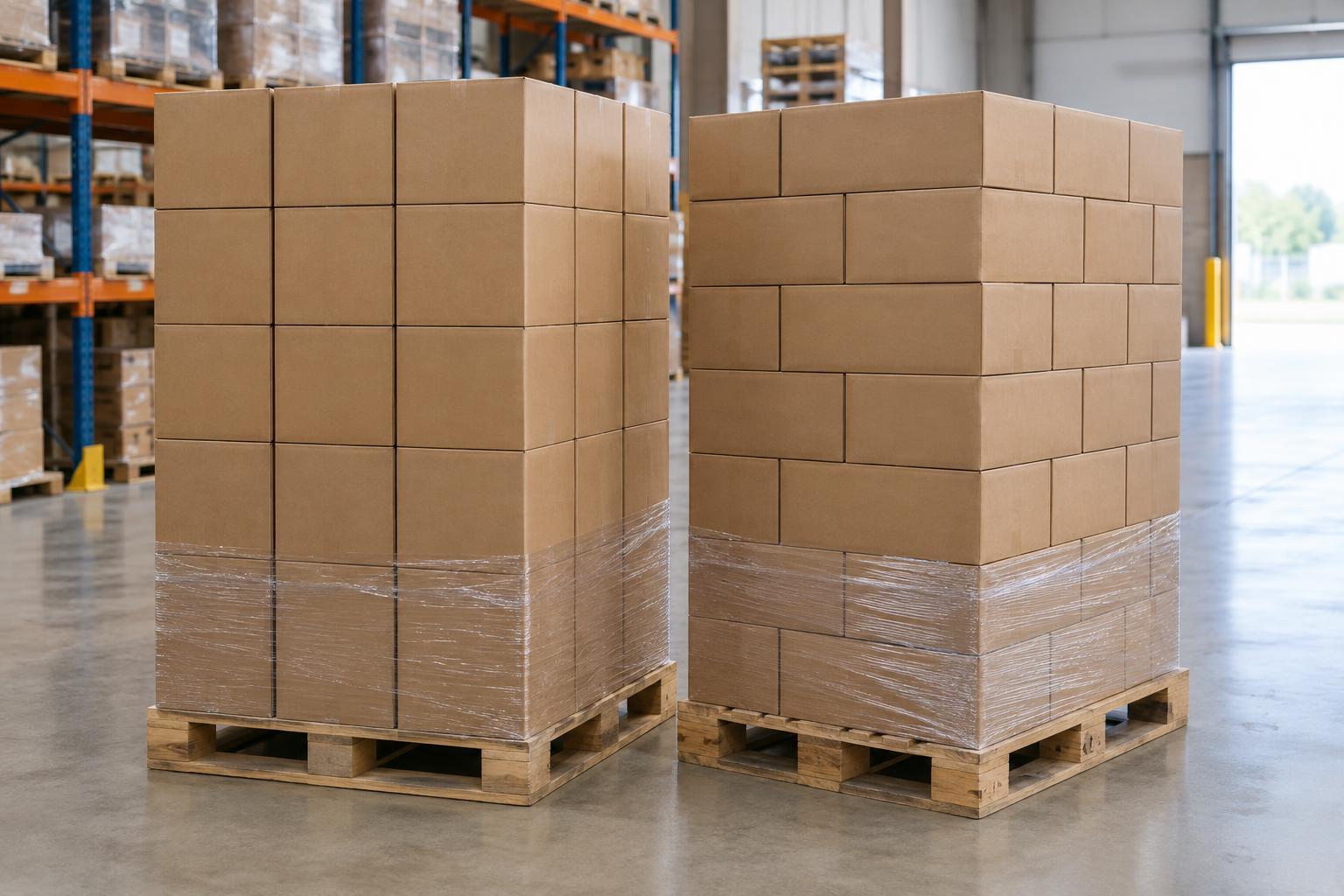
A pallet load needs to remain stable through lifting, turning, vibration and storage. Before choosing stretch wrap or strapping, look at what is being secured. Are the cartons uniform and closely stacked, or are there gaps and irregular shapes? Could individual items slide, tip or crush under pressure? A neat stack is easier to restrain than one with heavy goods on top, overhanging cartons or weak packaging at the bottom.
Also consider how the load meets the pallet. Film or straps may hold packages together without adequately connecting them to the pallet beneath. If the goods can shift as a single block while the pallet stays behind, the unit is not secure. Stack pattern, carton strength and suitable pallet support are therefore part of the decision, not separate problems that extra wrap or another strap will necessarily fix.
What stretch wrap does well
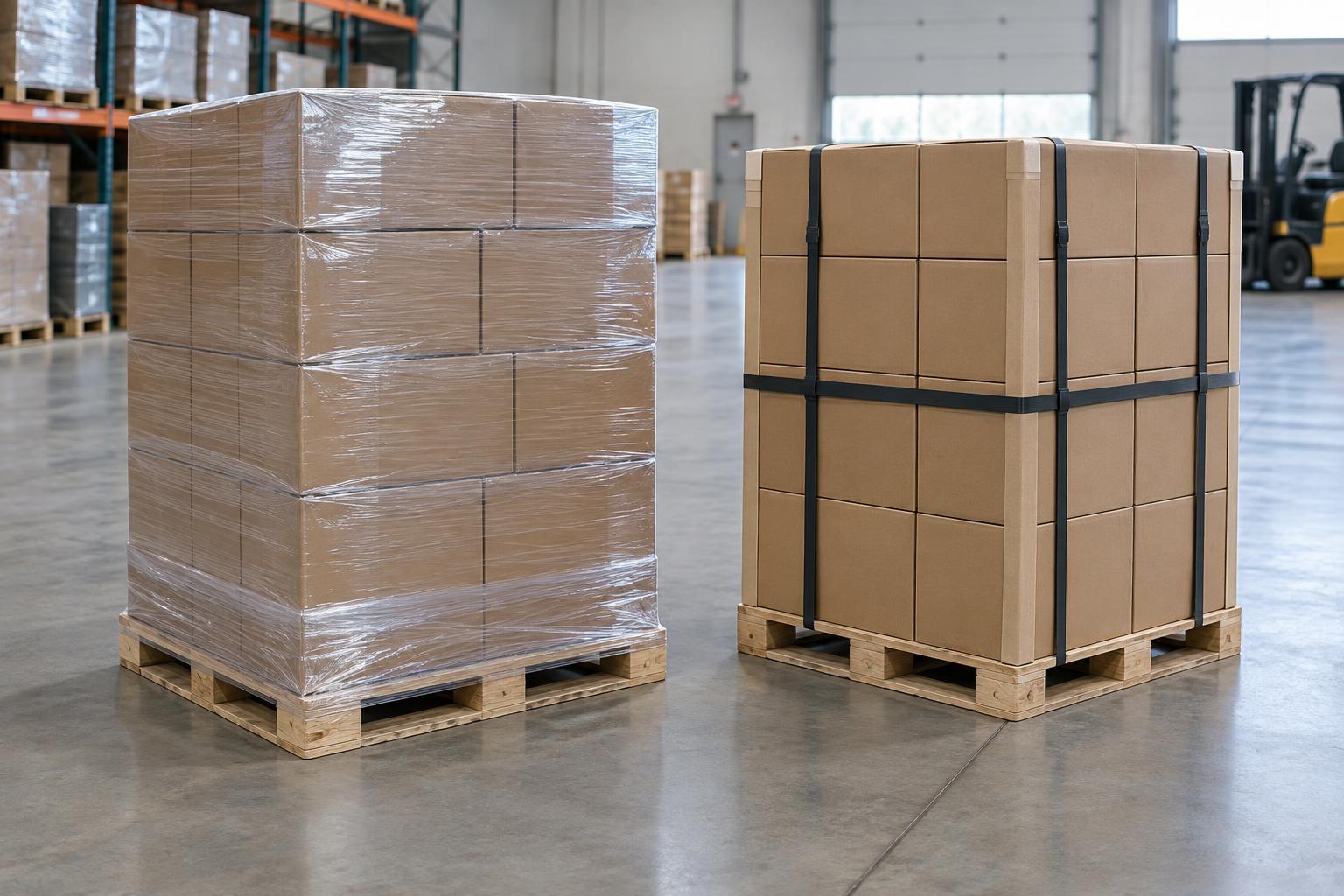
Stretch wrap is a plastic film applied under tension around a load. Its main advantage is broad containment: it can contact many cartons across several layers and help prevent small movements from growing into a leaning stack. It is often practical for regular loads made of boxed goods. Depending on the film and application, it can also provide a barrier against dust and light surface contact, although it should not be treated as weatherproof packaging.
Effective wrapping depends on more than the number of turns. The film needs appropriate tension, overlap and coverage, particularly around the lower part of the load. Wrapping that connects the goods to the pallet can help limit separation during handling, provided it does not interfere with fork entry or tear immediately on the pallet edges. Too little tension leaves a loose sleeve; too much may deform lightweight cartons or damage corners. Sharp projections can puncture the film and reduce its ability to contain the load.
What strapping does well
Strapping uses bands, commonly made from plastic or steel, to apply restraint along defined paths. It can be useful for heavy, rigid or awkward goods that need to be held tightly together or to a pallet. Because each strap acts along a narrow line, its placement matters: a band only helps where it can engage the load and remain in position. Loose cartons between straps may still move unless the stack is otherwise stable.
Strap tension and load strength must be matched. A strap that is too loose offers limited restraint, while one pulled too tightly can cut into cartons, damage products or crush edges. Corner boards or other protectors can spread the pressure and help keep straps from slipping around vulnerable corners. Strapping does not enclose the sides of a load, so it offers little protection from dust and does not, by itself, keep small items from escaping through gaps.
Choosing one method, or using both
For a consistent stack of cartons, stretch wrap may provide useful all-over containment with relatively simple application. For bundled profiles, large rigid items or loads that need restraint at specific points, strapping may be a better starting point. The choice also depends on the handling route: repeated transfers and rough surfaces create different demands from a short, controlled move within one facility. Neither material can compensate reliably for an unstable stack or an unsuitable pallet.
Some loads benefit from both methods. Straps can restrain heavier components or tie them to the pallet, while wrap contains smaller packages and limits surface movement. They should have distinct jobs rather than being added simply because the load looks insecure. If a load changes shape under handling, the tension in either material can change as well. Account for settling, compressible packaging and exposed edges when deciding where restraint is needed.
Check the finished pallet as a complete unit
After securing a load, inspect it from all sides. Look for leaning layers, overhang, torn film, straps cutting into corners and any gap that would allow goods to move. Confirm that the restraint reaches the pallet where required and that labels remain readable. A restrained load should be safe to handle without relying on a forklift driver to compensate for poor packaging.
A first successful lift is a useful observation, but it does not prove that a load will survive every journey. For repeat shipments, document the stack pattern and application method so that results are consistent, then review any damage or movement found after handling. When the goods or route change, revisit the method. The best choice is the one that keeps that particular load together and attached to its pallet without damaging what it is meant to protect.