What a shipping label needs to do
A shipping label connects a physical package to the information used to move it. It may carry an address, a tracking barcode, routing details and service instructions. People need to read some of that information, while scanners need to capture the barcode. A label can look acceptable at a glance yet fail at one of these jobs: the address might be partly hidden, or the barcode might be difficult to scan.
The barcode is especially sensitive to changes in its printed pattern. Wrinkles, missing lines, smudges and marks across the code can interfere with reading it. Most barcodes also need clear space around them so a scanner can distinguish the code from nearby text or graphics. Because label formats and requirements vary by carrier and service, use the applicable label template rather than redesigning or resizing it to fit a box.
Choose a flat, visible location
Place the label on a broad, flat face of the package where it can be seen without turning the parcel repeatedly. Keep the whole label on one face. A barcode that bends around an edge may be readable from neither side, and an address split across two faces is harder for a person to check. Leave enough room that the label does not overlap a seam, opening flap, handle, strap or closure.
Consider what may happen after packing. Tape added over a seam, stretch wrap around a carton or another package stacked against it should not obscure the label. On irregularly shaped items, a rigid outer carton or suitable label holder may offer a more reliable labeling surface than a curved or flexible product surface. If a carrier provides placement rules for a particular package type, follow those rules.
Protect the barcode without making it harder to read
A readable barcode depends on a clean print with clear contrast against its background. Print at the size specified by the label template, using a printer and label stock suited to one another. Check for faint patches, streaks, broken bars or ink that rubs off during ordinary handling. Enlarging a poor-quality image or repeatedly photocopying a label may preserve its visible outline while degrading the detail a scanner needs.
The label also has to stay attached. Apply it to a clean, dry surface and press it down firmly, particularly at the edges. Avoid folds and air pockets through the barcode. If a pouch or protective covering is needed, it should keep the label flat and clearly visible. Glossy coverings and tape placed across a barcode can create reflections or creases, so follow the carrier’s guidance and check that the finished package still scans.
Remove competing information
Reused cartons often carry old shipping labels, tracking codes or destination markings. Remove or completely cover obsolete information before adding the new label. Otherwise, a person or automated system may encounter more than one plausible instruction on the same package. Take the same care with promotional stickers and handling marks: they should not crowd the current label or cover its printed fields.
Before sealing a shipment batch, compare each applied label with the package it belongs to. Matching the correct label to the correct order matters as much as making the barcode readable. When several identical cartons are being packed, a simple one-at-a-time labeling routine can help prevent labels from being exchanged between parcels.
Make a final scanability check
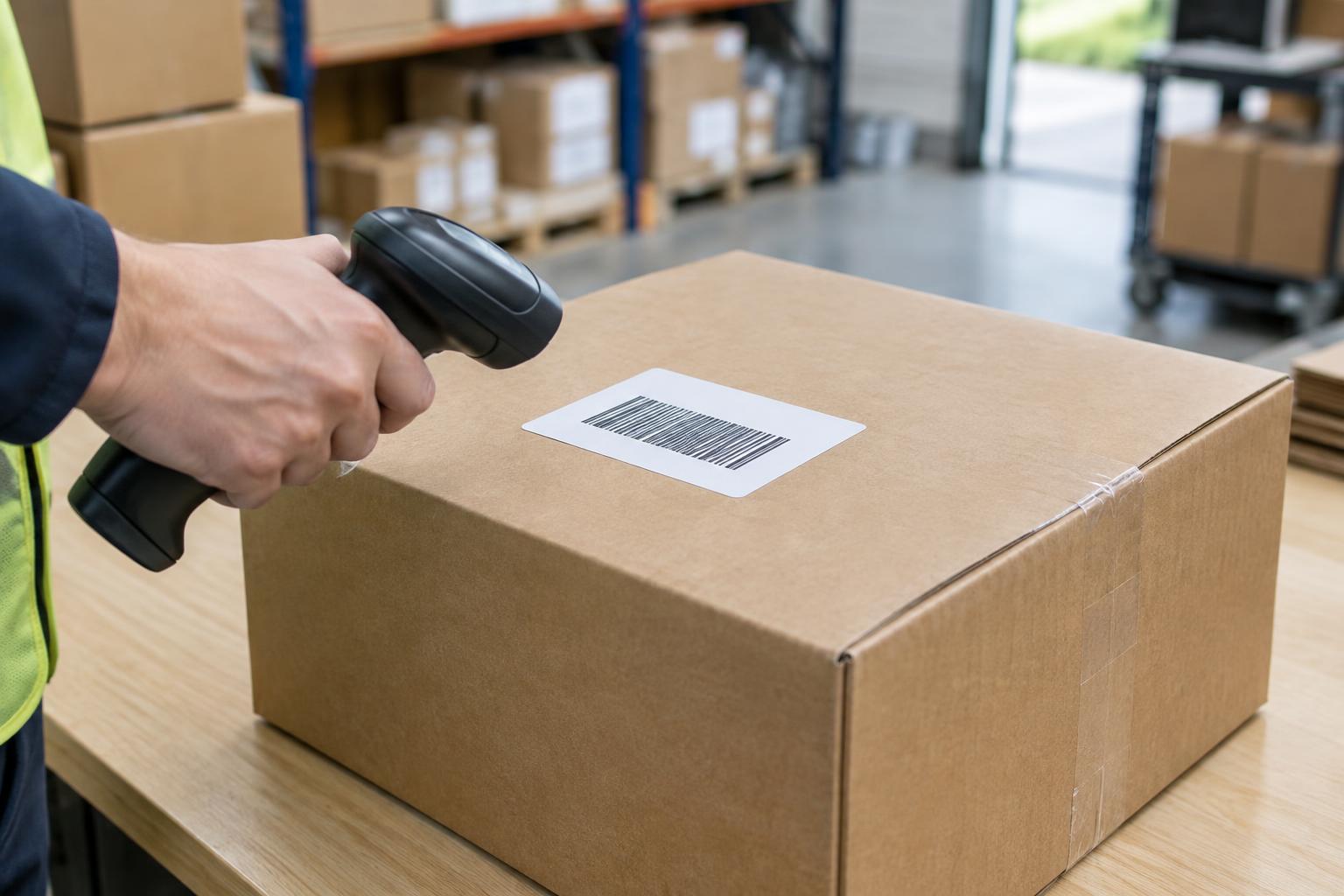
A useful final check takes only a moment: confirm that the label is fully attached, the address is legible, the barcode is flat and unobstructed, and no outdated codes remain visible. If a scanner is available in the packing area, test the finished package rather than only the loose label. That checks the printed code in its actual position, with any pouch, wrap or other covering in place.
A successful local scan is reassuring, but it does not replace the carrier’s specifications or guarantee how every scanner will handle the parcel. When a label is damaged, creased through the barcode or printed unclearly, replacing it is usually more dependable than trying to patch the defect. Treat placement and print quality as part of packing, not as a last-minute administrative step.