What happens at the seal
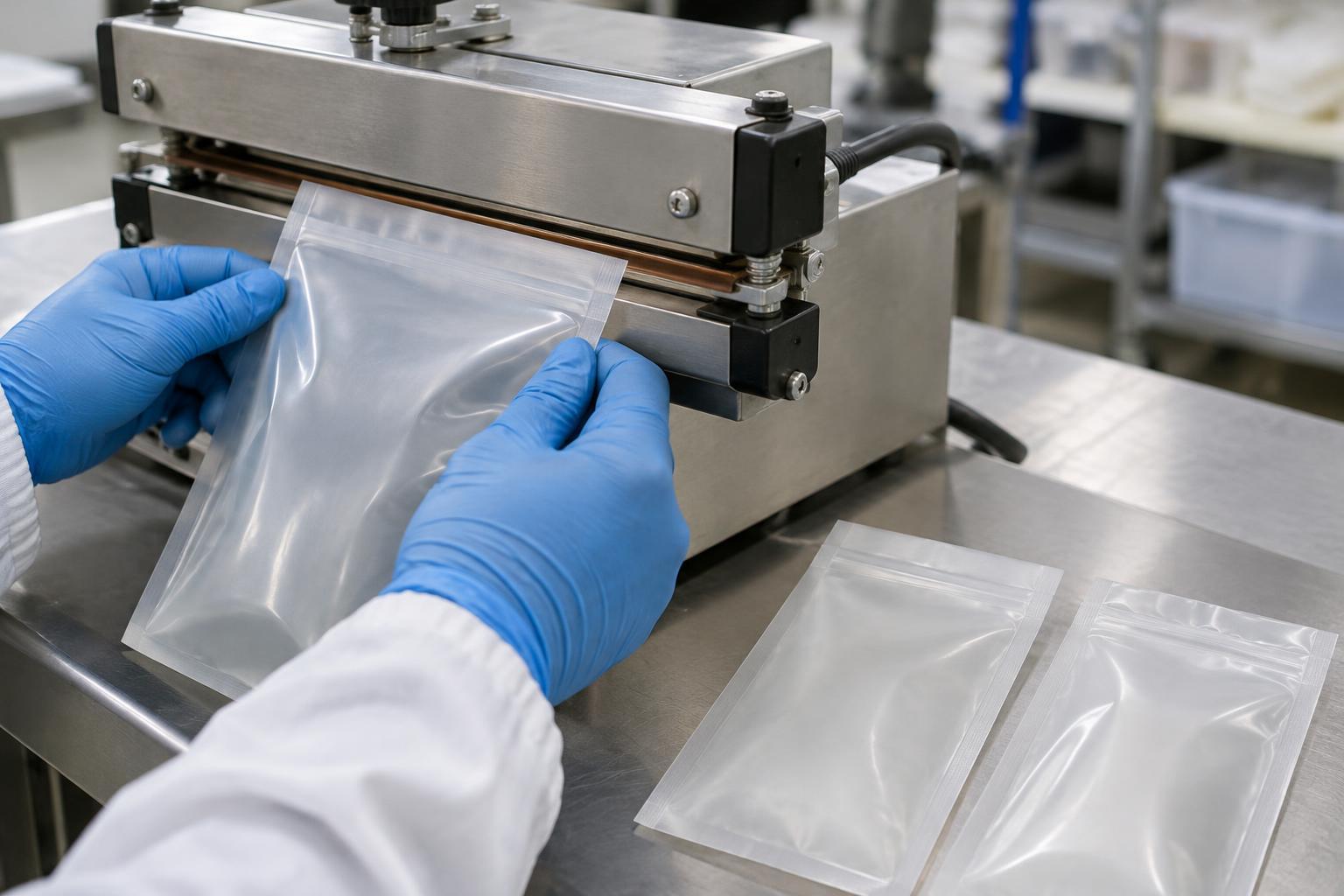
Many flexible pouches have an inner layer designed to seal to itself when heated. A sealing machine brings two pouch surfaces together under pressure while applying heat for a set time, called dwell time. The softened surfaces bond as they cool. The outer layers may provide strength, printability or a barrier to moisture and air, but the inner surfaces determine whether a conventional heat seal can form.
A good seal is a continuous bond across the full sealing area, not merely a line that looks closed. It must withstand filling, handling and transport without creating a path for the contents to escape or outside air to enter. The required performance depends on the product and the pouch design: a dry snack, a powder and a liquid can expose a seal to different stresses.
Choosing and maintaining seal width
Seal width is the distance across the bonded band, measured from the pouch edge toward its contents. A wider band can offer more room for a continuous bond and may be more forgiving of small variations in pouch position. It does not, however, repair a channel caused by a fold or a particle trapped between the layers. A narrow, uniform seal may perform better than a wide seal with an unbonded path through it.
Width is partly set by the sealing tool and the pouch layout. It must leave enough space for the product, any tear feature and the intended opening area. Consistency matters as much as the nominal width: a band that narrows at a corner or where a side seam crosses the top seal may become a weak point. When inspecting pouches, look at the full length of the seal, including both ends and any intersections.
Temperature works with time and pressure
The machine's temperature setting is not necessarily the temperature reached at the inner sealing surfaces. Heat must pass through the pouch material, and the result depends on material thickness, tool contact and line speed. Different sealant materials also behave differently, so there is no single temperature that suits every pouch.
Too little heat or too short a dwell time can leave areas insufficiently bonded. Excessive heat may distort the film, make it brittle near the seal or push softened material out of the sealing zone. Pressure helps the surfaces make even contact, but more pressure is not always better; uneven or excessive pressure can thin a seal or worsen wrinkles. Adjustments should therefore consider temperature, dwell time and pressure together rather than treating one setting as a universal fix.
Cooling is part of the process. A newly made seal can be weak while it is still hot, especially if a filled pouch pulls on it immediately after leaving the jaws. Supporting the pouch and allowing the bond to set can matter as much as the conditions during heating.
Common failures and what they suggest
A seal that pulls apart easily may indicate insufficient heat, dwell time or pressure, but it can also point to incompatible sealing surfaces or contamination. Oils, powders, crumbs and liquid caught in the seal area can prevent the layers from meeting. If failures appear mainly after filling, check whether the filling operation deposits product near the pouch mouth before raising the sealing temperature.
A leak does not always mean the entire seal is weak. A wrinkle, misaligned pouch edge or trapped particle may create a small channel through an otherwise strong band. Repeated failures in the same location can suggest a tooling or alignment issue. Irregular failures may be more consistent with variable filling, pouch presentation or material handling, though inspection is needed to distinguish them.
Visible scorching, shrinkage or a cut-like edge can indicate excessive heat or mechanical pressure. A seal that looks sound but fails during handling may need assessment of both its bond and the stresses applied after sealing. Appearance is useful for spotting patterns, but it cannot confirm that every pouch is leak-free.
A practical approach to checking seals
Start with the pouch supplier's material and sealing guidance, then establish settings on the actual equipment using the intended fill and line conditions. Inspect seals for uniform width, smoothness and contamination. Trial pouches can be opened to examine how the bond separates, and suitable strength or leak tests can help compare settings. The appropriate test depends on what the pouch must contain and how it will be handled.
When a problem appears, change one variable at a time and keep samples or records of the results. Check the cleanliness and condition of the sealing jaws, the accuracy of pouch positioning and the amount of product near the seal before assuming that temperature is the cause. Heat sealing is a process window rather than a single magic setting: dependable pouches come from compatible materials, controlled equipment and routine checks of the finished seal.